


Below is a brief overview of the production and usage of the world’s first postage stamps, as told through some of the spectacular, rare and unusual items we have on offer in our Great Britain auction on 20th June 2024.
Brief Background
The story begins with Sir Rowland Hill, the father of the postal reform who, from his booklet entitled “Post Office Reform: Its Importance and Practicability” in 1837, kicked off the uniform fourpenny post on 5th December 1839 and the uniform penny post shortly after on 10th January. It continued with the introduction of, in his own words, “a bit of paper just large enough to bear the stamp, and covered at the back with a glutinous wash” in May. This bit of paper became the world’s first postage stamps; the Penny Black and Twopenny Blue (see fig. 1).


Fig. 1: Lot 50216 in our upcoming June 20th 2024 auction series, an 1840 1d black pl.6 IA and an 1840 2d blue pl.1 AD, two stunning mint examples of the world’s first two postage stamps.
The Treasury Competition
After the Government’s acceptance of the postal reform proposals, the Treasury issued an invitation to artists, scientists and the general public to submit ideas and designs for the prepaid postage stamps and stamped paper. More than 2’600 suggestions and designs were submitted, and although there was no outright winner, four entries shared the prize money of £100; a joint entry by James Bogardus and Francis Coffin, Benjamin Cheverton, Henry Cole and Charles Whiting.

Fig. 2: Lot 50005 from our upcoming 20th June auction, an 1839 Treasury Competition essays, attributed to James Bogardus, showing a hand drawn numeral in pen and ink “1” in the centre of a red border and bearing the legend below ” 1/2 oz. / Penny” in manuscript
The Printers
Perkins, Bacon, Petch had been in correspondence with Rowland Hill and Henry Cole about printing as early as July 1839. In September they submitted some examples of Charles Whiting’s “POST OFFICE PERMIT” (fig. 3). They commissioned Henry Corbould to draw the Queen’s head and began experimenting with an engine-turned background. In early 1840 they produced an engraved plate showing two circles containing Britannia seated and six smaller circles containing the Lord’s Prayer (fig. 4). These intricate engine-turned designs were deemed the best method of security against forgery at the time.

Fig. 3: Lot 50010 from our upcoming 20th June 2024 auction, an 1839 Charles Whiting “Post Office Permit” lettersheet printed in green by Perkins, Bacon, Petch.

Fig. 4: Lot 50013 from our upcoming 20th June 2024 auction
In January 1840 they employed engravers Charles Heath and his son Frederick to commence engraving the portrait of the Queen on an engine-turned background. Four stages of the proofs exist; the first showing an early stage of the head engraving, the second with the head completed but uncleared spaces around, the third with the spaces engraved, and the fourth with the addition of “POSTAGE ONE PENNY” at foot. Figure 5 shows the unique example of the stage 4 proof with the legend excised. This engraving was rejected as being too fine to transfer well to the roller die and subsequently to the plate (as needed in the production of line engraved printing).
Work started on the second die in mid-January and it was completed by 23 January, showing a much darker background than the rejected die. It was approved by the Queen on 2 March. Essays for the inscriptions and corner squares at top and bottom began in February, with “POSTAGE” and “ONE PENNY” being selected along with stars in the top corners and check letters in the lower corners (which were to be punched onto the hardened plate).

Fig. 5: Lot 50016 in our upcoming 20th June 2024 auction, the January 1840 1st rejected die for the 1d stamp in black (fourth stage) with the words “POSTAGE ONE PENNY” excised
Cancellations
The possibility of reusing the stamps was a constant concern for Rowland Hill (see the Rainbow Trials section further down), so a way of obliterating the stamp rendering it unusable without detection was sought.
The first essay for an adhesive stamp showing a cancellation was that submitted by James Chalmers on 8th February 1838, and when he submitted essays for the Treasury Competition in 1839 he used the same Dundee two-line ds to obliterate his designs. Figure 6 shows the 1d and 2d essays he submitted to the Treasury Competition which feature in our 20th June 2024 auction of Great Britain. This idea of cancelling the stamp with a datestamp may well have originated from his ideas so these are important items in the history of philately.

Fig. 6: Lots 50003 and 50004 in our upcoming June 20th auction, two examples of the essays by James Chalmers submitted to the 1839 Treasury Competition.

There were four types of trial cancellation known to have been used; a barred circle, eight concentric circles with a sold centre (see fig. 10), a circular dated stamp and what philatelists know as the “Maltese Cross”. Fig. 4 shows lot 50043 from our upcoming June 20th 2024 auction, an archive piece showing a pair of Penny Blacks with the left example cancelled by a Maltese Cross endorsed “obliterating stamp”, and the right stamp with the circular datestmp. The Maltese Cross was the chosen device to cancel the stamps. The earliest record of it is in a letter written by William Bokenham, the Secretary of the Inland Office, on 31 March 1840, sent to Lt. Col. Maberly, Secretary of the Post Office:
“I beg to submit to your notice specimens of the stamp’s proposed for destroying the Penny and Two Penny Letter Stamps”

Fig. 4: Lot 50043 from our upcoming June 20th auction, a trial cancellation piece with a Maltese Cross and circular datestamp
The keyword seemingly being “destroying”! The handstamp was cut in brass, mass produced, and distributed to postmasters on 25th April 1840. Subsequent supplies were sometimes made locally and differ to a great or lesser extent from those manufactured in London. “The Maltese Cross” set of three volumes by Rockoff and Jackson is an essential resource to understand and identify these “distinctive Maltese Crosses“. Illustrated below in fig. 5 is a strip of six 1840 2d blue with six strikes of the distinctive Maltese Cross of York.
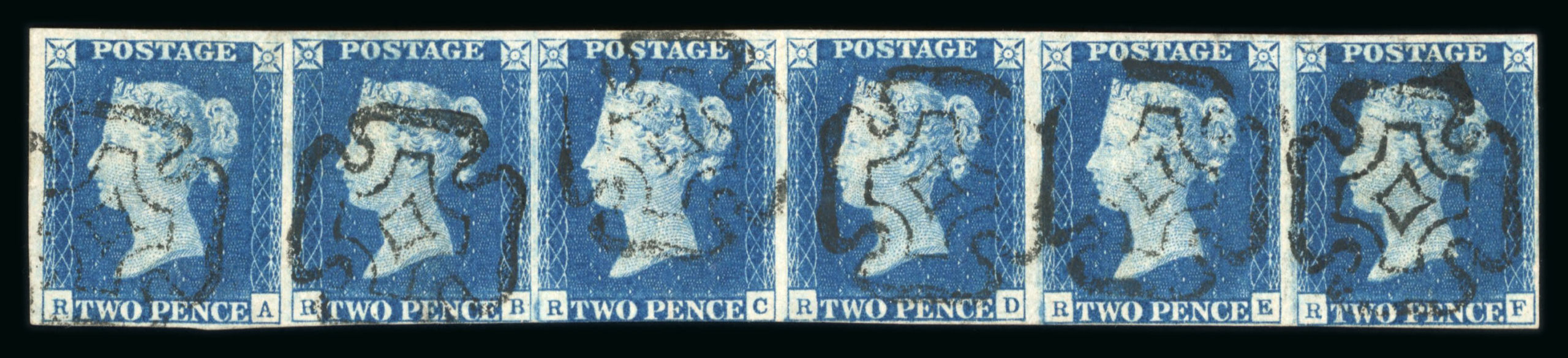
Fig. 5: Lot 50379 in our 20th June 2024 auction, a strip of six 1840 2d blue with the distinctive Maltese Cross of York
Although postal regulations were clear that the stamps should be cancelled with the Maltese Cross and back-stamped by the first receiving office, there are various examples of postmasters not conforming. Examples are known, and listed by Stanley Gibbons, with circular town handstamps both dated and undated (such as fig. 6, lot 50391, a marginal strip of 1841 1d reds with Cirencester datestamps), “Penny Post” handstamps, and later usages with 1844 numeral cancellations. Figure 7 is particularly unusual as it cancelled not only by the Maltese Cross but also by a “NEWENT / 117” mileage mark, which should have been phased out with the introduction of the uniform postage.

Fig. 6: Lot 50391 in our upcoming 20th June 2024 auction, an 1841 1d red marginal strip of five with Cirencester circular datestamps

Fig. 7: Lot 50395 in our 20th June 2024 auction, a Penny Black with a “NEWENT / 117” mileage mark
“The “Rainbow” Colour Trials
The “Rainbow” colour trials began in early May 1840, after the release of the Penny Black and Twopenny Blue, to test various combinations of stamp and cancellation ink in order to perform experiments to try to remove the cancellations. There were two plates produced to perform these trials. The first was a sheet of three impressions (fig. 8). These stamps were transferred from the defective roller impression showing the “O” flaw just to the lower right of the “O” in “ONE”. The north east corners of each impression were defaced to prevent their usage for postage. It has been historically thought that this was done with wax, but it is possible it was either done with a more durable filler or perhaps even ground down to achieve this effect.

Fig. 8: Lot 50025 in our upcoming June 20th auction, the first trial plate of three in blue-black on smaller crown watermark paper with manuscript notation “dipt H & H Colour” in the hand of Joshua Bacon down the right side
This format of three was likely not highly suitable for conducting experimental trials due to it’s size, and a second trial plate of 12 impressions was produced, using a different roller die than that used for the small trial plate as the impressions don’t show the “O” flaw. Two examples of these sheets without voided corners are known in the Royal Philatelic Collection and in the Postal Museum. In private hands, only impressions with voided corners exist.
There are three states with the voided corners that exist, that can be identified by minor markings such as the guidelines, burrs and size of the void. They were printed in over 20 shades of red, as well as in different blues, greens and in black. The paper was also sometimes treated with chemicals such as prussiate of potash (which would tint the paper blue) or with varnish.
Perkins Bacon usually conducted the experiments themselves, although Rowland Hill did some experiments independently. Perkins Bacon used a number of trial cancels including a “Bank of Ireland” oval, “A x 860”, “3860”, “GRIND”, “GRINDLAY CO”, “No. 71243” and “No. 712”.
Figure 9 shows a part sheet of 9 from state 3 on un watermarked white wove paper, dipped in Prussiate of Potash, which has been treated by various chemicals in an attempt to remove the cancellations. It shows the nine impressions cancelled by the “No 712” trial cancellation, with ink manuscript notes at top at sides in the hand of Joshua Bacon: “Prussic Acid”, “Potash”, “Tartaric Acid”, “Turpentine” and “Creosote”. “No 2” denotes the shade of blue and “D-4” the order of goodness as determined by Perkins Bacon.

Fig. 9: Lot 50029 in our upcoming 20th June 2024 auction, showing a part Rainbow trial sheet in blue with cancellation removal experiments
Paper and Gum Trials
Perkins Bacon also carried out paper and gum trials during this period. Illustrated in figure 10 is an archive large sheet bearing six 1840 1d blacks from plate 7 on the lighter weight paper (the normal weight being 30lbs per ream), annotated as “24lbs”, “26lbs” and “28 lbs” in the hand of L. de Nicolas (Rowland Hills clerk), each cancelled by concentric circles cancellation. The lower three stamps of each weight have had an overall brownish wash or varnish applied as part of the trial removal. The top of the sheet bears three gummed paper samples with “present gum”, “New dark No.1” and “New light No.2” in the hand of Joshua Bacon above.
The experimental lighter paper was used to print plate 7, and illustrated in figure 11, the most important item in our 20th June auction series, is a stunning mint marginal block of 12, which once graced the collections of “Daisy” and Bill Gross.

Fig. 10: Lot 50030 in our upcoming 20th June auction of Great Britain

Further Reading
“The British Postage Stamp of the Nineteenth Century”, by Robson Lowe
“The Maltese Cross”, three volumes, by Mike Jackson
“Rainbow Trials” by David Rowse (available to buy through the GBPS)
“The Queens Own, Rainbow Trials”, Smithsonian National Postal Museum website
“Queen Victoria Part 1” by Stanley Gibbons