


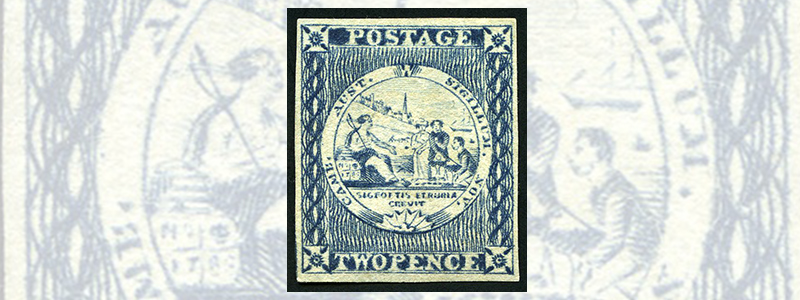
Our June 30th-July 2nd auction series features a strong section of New South Wales from the “Tatiana” collection, including an incredible offering of unused Sydney Views, with many of the stamps having previously passed through the hands of some of the great New South Wales collectors.
The following are a selection of extracts from an article in the “Encyclopaedia of Rare and Famous Stamps: 1. Stories” by L. N. Williams, that David Feldman published in 1993.
The Australian States are the homes of classic issues; some of them have attracted popular philatelic attention from the earliest days. While several issues clamour for attention there can be no doubt that two series stand pre-eminent : the Sydney Views of New South Wales and the Swans of Western Australia. Both are first issues of the relevant states. The Sydney Views first appeared in 1850, the Swans in 1854. Coincidentally, two extremes of the classics are represented : first, those produced from soft copper plates by craftsmen locally and, secondly, those produced from highly finished steel plates prepared in London.
Nomenclature
What have become known as the Sydney Views, were originally called Gold Diggings from a fancied resemblance of the design to gold mining, and later became generally called The Sydney Stamps.
In the first general meeting of the Philatelic Society, London on 29 May 1869 the president, Sir Daniel Cooper, who had been a member of the Legislative Council of New South Wales which passed the statutes relating to the stamps, read a paper “On the Earliest Sydney Stamps and Proofs of the Sydney Views”. This is the first reference I have traced to the use of the nickname Sydney Views. “The Earliest Sydney Stamps” to which the title referred were the letter sheets and envelopes with an embossed stamp issued in 1838 franking letters delivered twice a day within the limits of the city of Sydney.
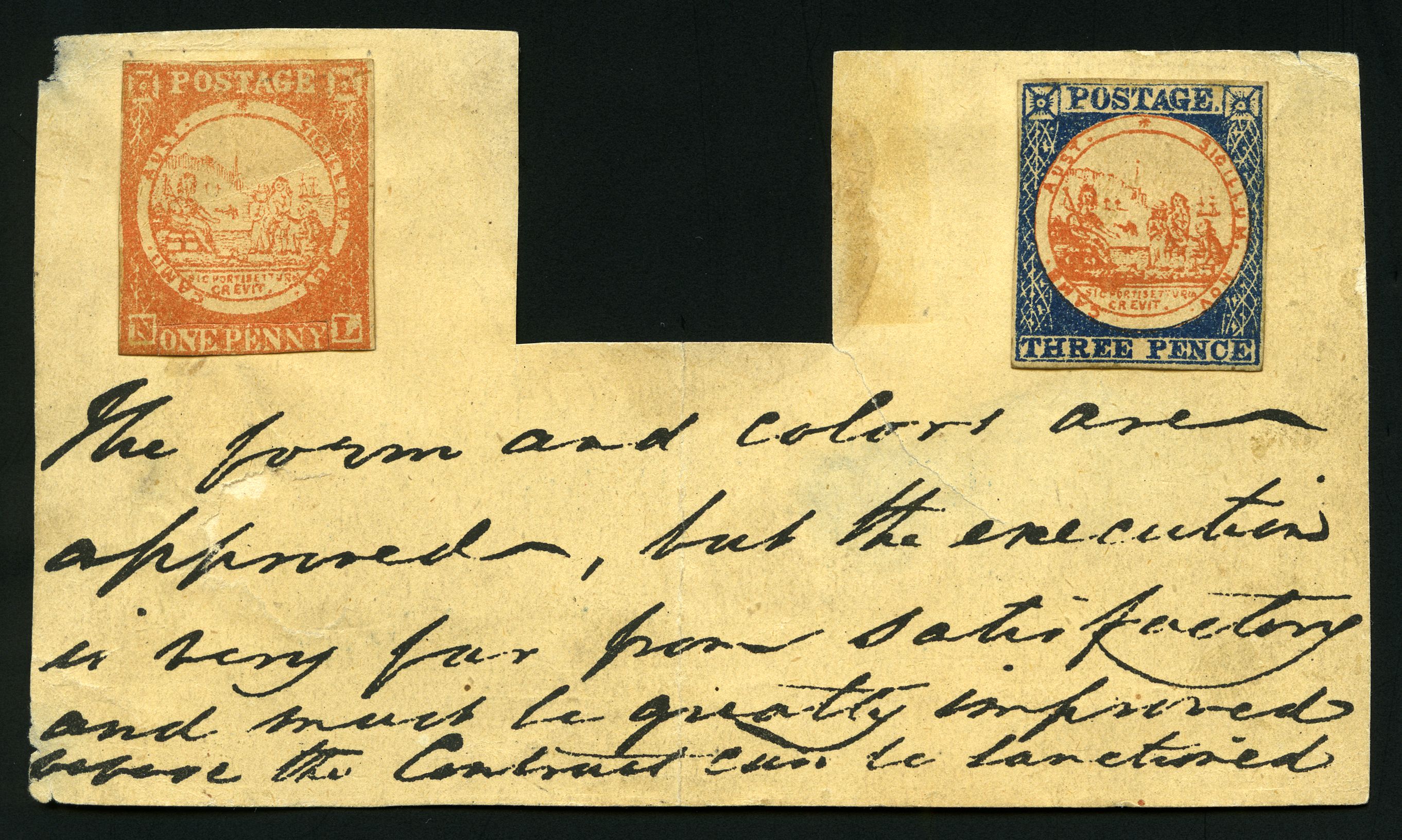
Lot 30744 in our June 30th-July 2nd auction series, a facsimilie of the “Sydney View” essays by Alfred Clayton. The original essay is in the Tapling collection held by the British Library
Design
Andrew Houison, an enthusiastic philatelist and researcher into official archives in Sydney, had published an article titled ‘The Early Postal Issues of New South Wales’ in “The Philatelic Record” vol 10 pp 45-47 March 1888, in which he set out a letter of 1849 recording payments for engraving the copper plates from which the Sydney Views had been printed. He ended up by commenting that many points remained to he cleared up in reference to the stamps, and concluded:
One further subject suggests itself : that is, the design in the centre of the stamps. I do not remember having seen in any Philatelic publication an exact description of this. It is a copy of the old Great Seal of the Colony. The three figures on the right are immigrants landing at Sydney, received by Industry, who — surrounded by her attributes, a bale of merchandise, a beehive, a pickaxe, and a shovel — is pointing to oxen ploughing, and a town rising on the summit of a hill, with (what was intended for) a fort for its protection. The masts of a ship are seen in the Bay. In the margin are the words, SIGILLUM NOV. CAMB. AUST., and for a motto, SIC FORTIS ETRURIA CREVIT. The original seal was of silver, and the devices were extremely well engraved.
Engraving and Plating
Early on it was realised that individual stamps differed from others. Consequently no one could be sure that the separate piece of printed paper they had in front of him was a genuine stamp or a forgery. Before they could be sure one way or the other he had to establish the size and format of the plate and the position occupied on it by the subject resulting in a stamp exhibiting a particular set of characteristics.
The sheet format was established by the use of marginal examples and unsevered multiples. Overlapping stamps with identical sets of characteristics until no further extension horizontally or vertically of the format thus obtained was possible and all the individual examples, whether dissevered or still in unsevered multiples could be fitted into the pattern thus established. When that stage was reached the stamp had been plated.
Complications arose when it was realised that impressions on the printing plates had been repaired by the re-cutting of lines of the design, termed re-engraving. Overcoming these complications involved referring to the various stages of the plate when impressions were printed from it, as State 1, State 2, and so on. In the cases of the Sydney Views these states are still, following long tradition, referred to as Plate I, Plate II and so on, even though only a single piece of metal was involved for each value.
The plating of the Sydney Views was accomplished before publication of “The Postage Stamps… of Australia” and autotype illustrations of reconstituted sheets of stamps formed part of the work. They showed that the plates of the One penny and Three pence Sydney Views, each of which bore 25 subjects, were conventionally arranged in five rows of five. However, the plates of the Two pence consisted of 24 subjects arranged in two rows of 12.
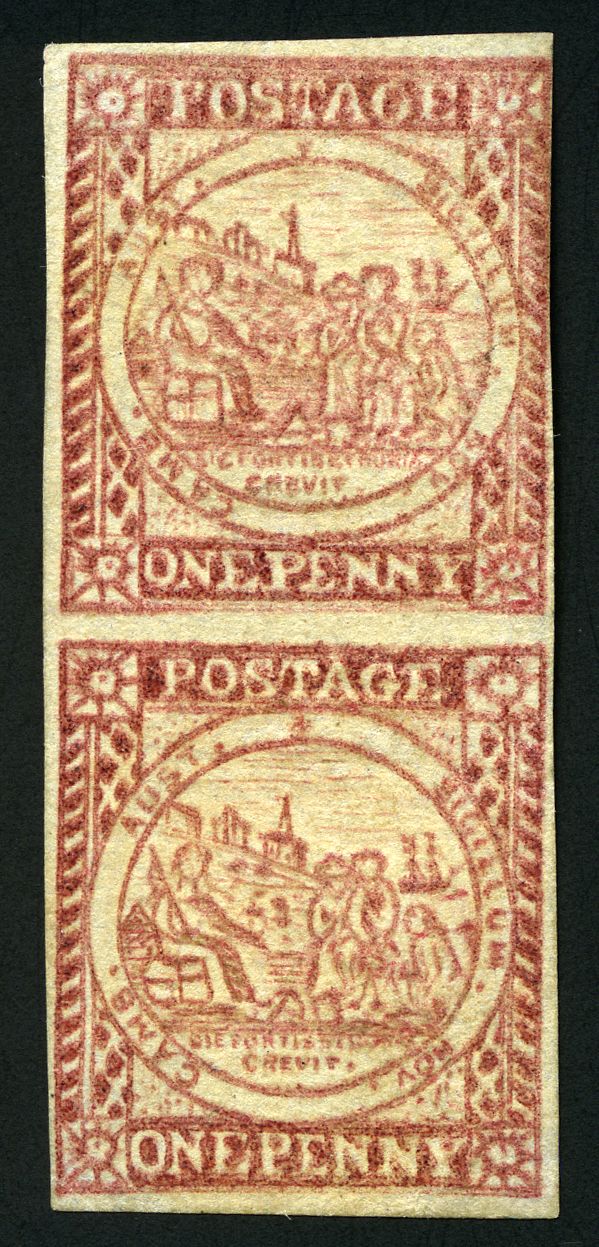
Lot 30759 in our June 30th-July 2nd auction series, a mint 1850 Sydney View 1d vertical pair from state 2, showing re-engraved clouds
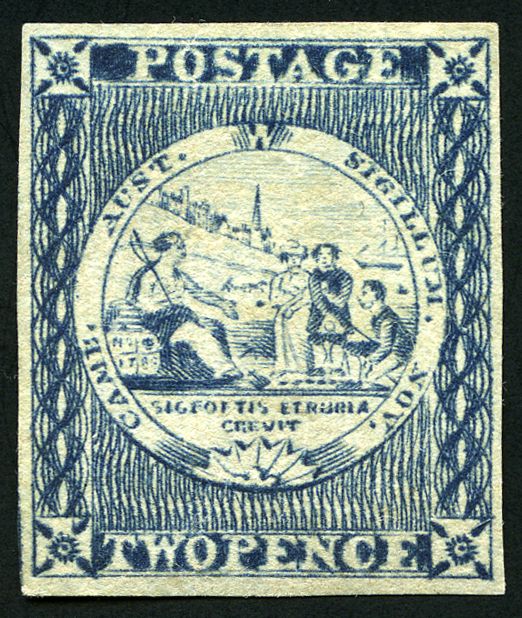
Lot 30768 in our June 30th-July 2nd auction series, an unused 1850 Sydney View 2d from state 1
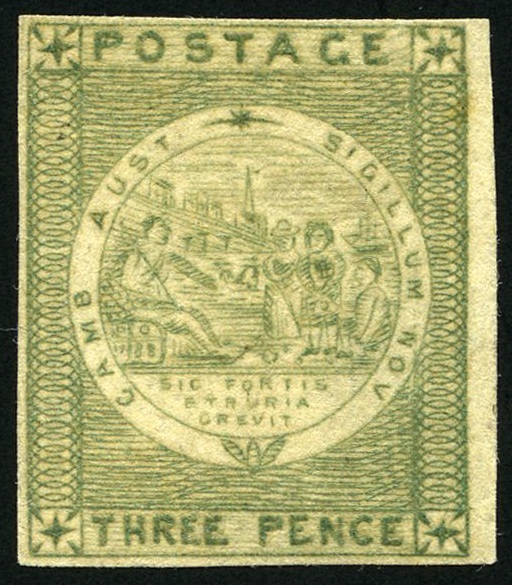
Lot 30768 in our June 30th-July 2nd auction series, an unused 1850 Sydney View 3d in the very rare myrtle green shade
The Two pence plate was engraved by John Carmichael, who was paid £12 12s. for his work. Robert Clayton, who engraved the One penny plate, was paid £10, and, for engraving the Three pence plate, H.C. Jervis was paid £7. Only the Three pence plate did not have to be repaired throughout its use. Jervis re-engraved the One penny plate once and the Two pence plate four times.
The philatelic complexity of the Sydney Views, their colours and the papers on which they were printed, may be judged from the fact that the three values of stamps, which were in use for only some two years, occupy no less than 43 major numbers in Stanley Gibbons Stamp Catalogue; in addition there are numerous minor numbers. Robson Lowe, in his “Encyclopaedia of British Empire Postage Stamps Volume IV The Empire in Australasia” 1962 lists the three values of stamps under 19 numbers, and includes further varieties to those appearing in the Stanley Gibbons work.
Printing
A variety of the Two Pence, mentioned by Stanley Gibbons, is referred to by Robson Lowe as (VVV), meaning that it is of the greatest degree of cost; it is RL 10, variety vi Tête-bêche pairs. I know of only a single example of the variety. It came to light in 1903 on a cover discovered by Fred Hagen, the dealer, of Sydney. The pair is from Plate II and is referred to as in the medium worn state.
The printed sheets of Two Pence Sydney Views comprised 48 stamps in two panes, the panes being inverted in relation to each other. That happened because, after the press had operated on the sheet of paper, which was much larger than the plate, the sheet was removed from the press, turned through 180 degrees and, after the plate had been re-inked and wiped, inserted again in the press to receive the second impression.
The reason for such a clumsy procedure with a recess-engraved and intaglio printed plate has never been satisfactorily given. The suggestion usually made is that the press could not operate on so large a piece of paper. However, that would seem to be belied by the facts that the press accommodated not only the plates for the other values bearing five rows of five but also the plate of the Two pence bearing two rows of 12. Any difficulty, therefore, would seem to have arisen not from the size of the sheets of paper but from the arrangement of two rows of 12 which was most unusual. Why that arrangement was adopted has also not been explained in detail.
The Unique Tête-Bêche Cover

Illustrated with kind permission from Joseph Hackmey
Because of turning of the sheet, stamp number 12 and stamp number 1 occurred on a tête-bêche pair and indeed, that is the arrangement, reading from left to right, on the cover itself where the pair appears horizontally at the top right corner.
The cover is headed OHMS and is addressed to His Honor / C. I. La Trobe Esqre / Superintendent / Melbourne. At the left, in the lower corner, appears Col: Treasury / 30th July 1850 and a flourish in a vertical spiral. Two unframed postal markings appear on the reverse: SYDNEY / Crown / JY 30 / 1850 / NEW SOUTH WALES, which is circular and MELBOURNE / * / AU*8 / 1850 / PORT PHILLIP, which is oval.
When commenting on the discovery, which had been reported in the “Australian Journal of Philately” for November 1903 and referred to in “The London Philatelist” vol 12 pp 301-302 December 1903. Basset Hull wrote:
Doubtless in most cases the two impressions were severed before being placed on sale at the Post Office, but the pair under review being from the supply used by an important Government Department, was probably cut straight from the ‘double’ sheet, the two impressions being so close together that it was considered unnecessary to sever them. Had this pair been at the disposal of the original ‘platers’ of the Views, I am inclined to think it would have very considerably delayed and hampered them in the labours which they brought to such successful conclusion. It would have at once led them to believe that there were more than two rows on the plate, and caused them to despair of ever reconstructing a plate!
The cover with the tête-bêche pair was bought by Tom Allen, the dealer shortly before World War II, and he lent it to me to photograph. Later he sold it to Alfred F. Lichtenstein. It passed to his daughter, Louise Boyd Dale and after her death it became the property of the Anne Boyd Lichtenstein Foundation, of New York, where the cover remained until the Foundation’s collection was sent for auction by Harmers of New York. The sale of the cover took place in on 14 May 1990, as lot 60, it cost the buyer £49’500. It is undoubtedly the rarest variety of any of the Australian States.
PS. Since the publication of this article, the cover was sold in the Manwood collection of New South Wales in 1995, where it was presented on the front cover, and sold for $165’000.
Further Reading
For those interested in more details about these famous and popular issues, you can read the entire article entitled New South Wales Sydney Views from the Encyclopaedia of Rare and Famous Stamps by L. N. Williams here.
Also of interest will be the article in the May 2020 London Philatelist by David Beech MBE RPSL entitled “New South Wales: 1850 Sydney Views’ Essays”.
Here is a list of David Feldman auctions with PDFs which have included specialised sections of New South Wales:
1987 (Nov): Australasia, David Feldman SA, 200+ lots
2000 (May): Victor Frankenstein Large Gold Medal Collection, 175+ lots
2002 (May): The Dale Forster collection of NSW postal history and the Trevor Davis Grand Prix collection of Australian States (prices realised)