


Lot 417 – JEAN-BAPTISTE-SIMÉON CHARDIN (Paris, 1699 – Paris, 1779)
Lot 417 – JEAN-BAPTISTE-SIMÉON CHARDIN (Paris, 1699 – Paris, 1779)
JEAN-BAPTISTE-SIMÉON CHARDIN
(Paris, 1699 – Paris, 1779)
(attribué à)
La Femme aux œufs
Vers 1726
Huile sur toile, signée « S. Chardin »
129 x 97 cm
Exposition
Versailles, 1867, n° 121
Provenance
Marquis De Billoty, Orange
J. Berwind, New York
Publication
Reproduit dans Catalogue raisonné de Chardin, Wildenstein, 1969 (n° 9, p. 142 ; fig. 5, p. 143)
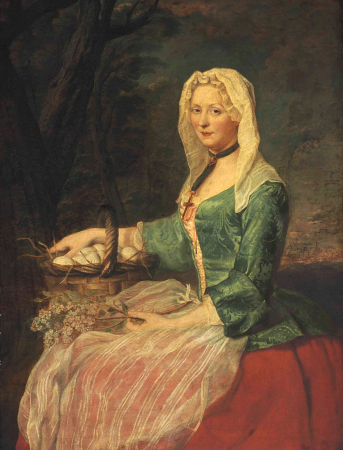
Assise au milieu d’un paysage champêtre, cette jeune femme au regard paisible semble revenir tout juste de la ferme voisine, un panier d’œufs frais à la main. Malgré le décor rural, elle adopte une posture digne, comme si elle posait dans un intérieur bourgeois. La main droite, protectrice, veille sur les œufs, tandis que la gauche, plus relâchée, tient délicatement une branche de lilas – discrète allusion à sa promenade.
Sa tenue soignée évoque la petite bourgeoisie : un bonnet de dentelle surmonté d’un fichu de lin blanc dissimule sa chevelure, une croix dorée pend au bout d’un ruban de velours noir serré autour du cou, et son corsage à basque en soie damassée vert d’eau dialogue avec la jupe rouge vermillon. Un tablier de gaze blanche complète l’ensemble, apportant une touche de légèreté vaporeuse.
Le peintre excelle ici dans le rendu des matières à travers une savante palette de blancs : mat pour évoquer la fraîcheur des œufs, transparent pour figurer la délicatesse des tissus. La carnation de la main, d’une blancheur porcelaine, contraste avec les joues légèrement couperosées du modèle, rappel discret de son origine modeste et de l’intimité du portrait. Il n’y a ici aucun artifice mondain, mais une sincérité touchante dans la représentation.
Le modèle pourrait être Marguerite Saintard, épouse de Chardin, qu’il rencontra en 1724 et qui mourut prématurément en 1735. Bien que la toile soit signée « S. Chardin », l’attribution demeure prudente, faute de documentation confirmant sa main. Néanmoins, la qualité de l’exécution – le rendu des étoffes, la délicatesse du teint, la finesse des pétales de lilas – témoigne d’une grande maîtrise, dans la lignée du style du maître.
Ce portrait intime, « peint avec le sentiment » selon les mots de Chardin lui-même, rappelle les figures féminines du Bénédicité du Louvre ou de La Jeune fille au volant des Offices. Bien que Chardin ait principalement consacré son œuvre aux natures mortes, ce tableau témoigne d’un talent certain pour la figure humaine. Pourrait-il s’agir de l’un de ses rares portraits, ou de l’œuvre d’un talentueux suiveur tel que Nicolas-Bernard Lépicié ?
JEAN-BAPTISTE-SIMÉON CHARDIN
(Paris, 1699 – Paris, 1779)
(attributed to)
The Woman with Eggs
Circa 1726
Oil on canvas, signed “S. Chardin”
129 x 97 cm
Exhibition
Versailles, 1867, no. 121
Provenance
Marquis De Billoty, Orange
J. Berwind, New York
Publication
Reproduced in Catalogue raisonné de Chardin, Wildenstein, 1969 (no. 9, p. 142; fig. 5, p. 143)
Seated in the midst of a rural landscape, this young woman, who gazes at us calmly, seems to have just returned from a nearby farm, bringing with her a basket of fresh eggs. Despite the rustic setting, she poses with poise, as if she were sitting in a bourgeois interior. Her right hand protectively cradles the eggs, while her relaxed left hand delicately holds a lilac branch—another token of her countryside walk.
Her carefully arranged attire suggests a modest bourgeois background: a lace bonnet covered by a white linen kerchief modestly conceals her hair; a gold cross hangs from a black velvet ribbon tied around her neck; and her peplum bodice, made of moiré-patterned silk in a watery green hue, pairs naturally with the vermilion red of her voluminous skirt. A sheer white gauze apron completes the ensemble, adding a soft, airy touch.
The artist displays exceptional skill in rendering various materials through a masterful range of whites: matte to suggest the freshness of the eggs, translucent to capture the lightness of lace and gauze. The milky whiteness of the eggs highlights the porcelain complexion of her hand, yet contrasts with the slightly flushed cheeks of the young woman—a subtle indication of her humble origins and the intimate context of the portrait. There is no use of makeup to suggest aristocratic status, only a freer, truer rendering of her features.
The sitter is thought to be Marguerite Saintard, Chardin’s wife, whom he met in 1724 and who sadly passed away in 1735 at a young age. Despite the presence of the signature “S. Chardin,” the authorship remains uncertain due to a lack of documentary evidence. Nonetheless, the painting’s high quality—the texture of fabrics, the lifelike skin tones, the delicate lilac petals—demonstrates remarkable virtuosity in the style of the master.
This intimate portrait, “painted with feeling” as Chardin himself advocated, recalls the young women depicted in The Prayer Before Meal (Louvre) and Girl with a Shuttle (Uffizi), both bearing a similarly rosy complexion. Though Chardin painted relatively few portraits, preferring the still lifes for which he became famous, this work is clearly executed by a highly skilled hand. Could it, perhaps, be the work of Nicolas-Bernard Lépicié, one of Chardin’s most talented followers?
Additional scans and images are being uploaded on a continuous basis, and the complete set of illustrations for all lots will be available by 1 June 2026.
Should you require further images after this date and are unable to find the material you need online, please do not hesitate to contact us.
For further information regarding this lot, please contact us.