


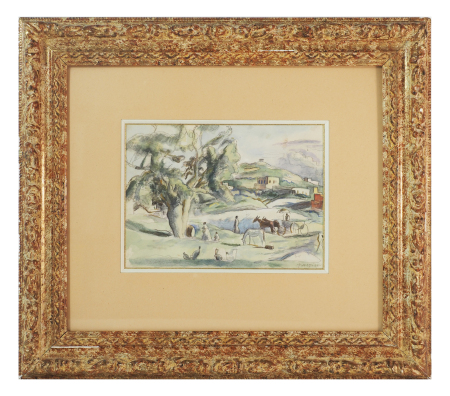


Lot 461 – Jules Pascin (1885 Vidin Bulgarie–1930 Paris)Scène
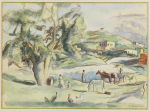
Scène de village oriental
Aquarelle et crayon de graphite sur papier
Signée en bas
Dimensions à vue : 16 × 22 cm
Issu d’un riche parcours international, Jules Pascin – né Julius Mordecai Pincas à Vidin en Bulgarie – fut une figure essentielle mais inclassable de la modernité artistique du début du XXe siècle. Surnommé « le prince de Montparnasse », il partagea les affinités et les nuits des artistes de l’École de Paris, sans jamais se laisser enfermer dans une école ni un style.
Après une première reconnaissance à Berlin, il s’installe à Paris, où il devient un chroniqueur subtil des marges sociales et de la sensualité humaine. S’il a souvent été associé à l’expressionnisme, au fauvisme ou à l’École juive de Paris aux côtés de Chagall ou Modigliani, l’œuvre de Pascin demeure profondément libre, traversée d’un humour tendre et d’une grande acuité psychologique.
L’œuvre présentée ici, Scène de village oriental, est emblématique de la période maghrébine de Pascin. L’artiste séjourne en Algérie et en Tunisie à plusieurs reprises entre 1921 et 1926, trouvant dans ces terres une source d’inspiration renouvelée. Ces voyages nourrissent un regard plus contemplatif, baigné de lumière et de chaleur.
Provenant de l’importante collection de Georges Couturat, mécène et marchand influent du Paris artistique, cette œuvre témoigne aussi du réseau d’amitiés et de soutiens qui entourait Pascin tout au long de sa carrière.
Jules Pascin (1885 Vidin, Bulgaria – 1930 Paris)
Oriental Village Scene
Watercolor and graphite pencil on paper
Signed at the bottom
Visible dimensions: 16 × 22 cm
Jules Pascin—born Julius Mordecai Pincas in Vidin, Bulgaria—was a key yet unclassifiable figure in the modernist art movement of the early 20th century. Nicknamed “the Prince of Montparnasse,” he shared the affinities and nocturnal life of the artists of the École de Paris, while never confining himself to a single school or style.
After gaining initial recognition in Berlin, Pascin settled in Paris, where he became a subtle chronicler of society’s margins and human sensuality. Though often associated with Expressionism, Fauvism, or the Jewish School of Paris alongside artists like Chagall and Modigliani, Pascin’s work remained deeply independent, marked by tender humor and sharp psychological insight.
The work presented here, Oriental Village Scene, is emblematic of Pascin’s North African period. The artist traveled to Algeria and Tunisia several times between 1921 and 1926, finding in these lands a renewed source of inspiration. These journeys brought a more contemplative gaze to his work, suffused with light and warmth.
Provenance: Coming from the important collection of Georges Couturat—a prominent patron and influential dealer in the Parisian art scene—this piece also reflects the network of friendships and support that accompanied Pascin throughout his career.
Additional scans and images are being uploaded on a continuous basis, and the complete set of illustrations for all lots will be available by 1 June 2026.
Should you require further images after this date and are unable to find the material you need online, please do not hesitate to contact us.
For further information regarding this lot, please contact us.