


Lot 30200 – 1874, 6 sen violet brown with syllabic 6 (he)
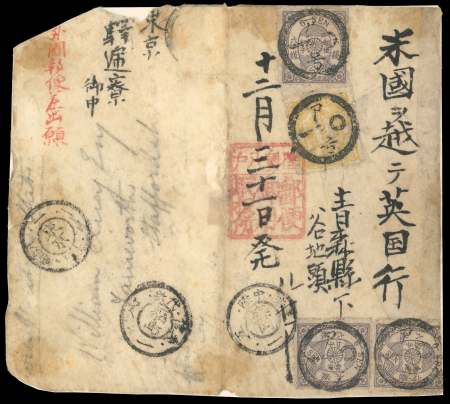


Lot 30200 – 1874, 6 sen violet brown with syllabic 6 (he)
Japan » 1874, Cherry Blossoms, Native Paper, with syllabics
Price realised
75’000 EUR
Estimate
50’000 – 75’000 EUR
Auction date
Sat 3 Jun 2023 at 11:30 (Europe/Zurich)
Description
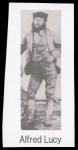
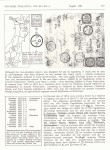
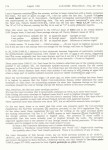
THE UNIQUE OUTSIDE ENVELOPE OF THE DOUBLE-ENVELOPE SYSTEM1874, The Hachinohe cover under the double-envelope system (see note in the previous lot): Addressed to the Tokyo General Post Office for the Foreign Mail dispatching process, franked by 6 sen violet brown on native paper, syllabic 6 (he), pair and single (an additional example overlapping the edge missing) and 2 sen yellow on foreign paper, syllabic 4 (ni), each tied by “Kiban” a-10 circular postmark of Hachinohe (Mutsu Province) carried via Morioka (Jan. 5) and Fukushima (Jan. 9), with “Tokyo 8.1.12” (12 January 1875) receiving cds, alongside showing clear strike of framed early non-standard “Mutsu Hachinohe / Postal Handling Agency” postmark in red. Cover slightly reduced on all sides. Certificate Florian Eichhorn BPP (2023).The cover is addressed to William Henry Lucy in Tamworth, Staffordshire (England), and bears a handwritten “sent 12th month 31st day Rusei” notation by the foreign advisor Alfred Lucy.As there are no foreign markings and Tokyo is the latest dated postmark, this outer envelope ended its journey at Tokyo GPO (see note in the previous lot). Handwritten endorsements on address side include “Tokyo / General Post Office” in black and “Request to send mail overseas” in red, Japanese notations on reverse are “via USA to England” and “sent 12th month 31st day Lucy” (below the red postmark), as well as sender’s address being Alfred Lucy’s farm in Yachikashira in Aomori Prefecture.Franked under the special rate of the “foreign mail procedure” using the double-envelope system, with the postage for the inland letter being 2 sen per 2 momme (7.5 grams) if posted outside Tokyo or Yokohama, and 24 sen per 4 momme (15 grams) for a letter to Great Britain according to the 3rd “foreign mail procedure” rate period from 1st January to 31st December 1874.The double-envelope system was part of the “Foreign Mail Procedure” regulation which existed between 8 April 1872 (Meiji 5.3.1) and 9 September 1875 (see previous lot). For a detailed discussion about this item, see Dr. Spaulding in JP Vol. 46 (1991) 4 pp.177-178 and Dr. Tani in “Zen Nihon Yushu” 12/1990. Cf, also Dr. Spaulding in JP 15/62-71, 18/30-31, 20/146-150, and Sawa/Chikatsuji/Tani in “Zen Nihon Yushu” 9/1985 pp. 277-280.As a proof of the scarcity of this system, in 1873 and 1874 only 725 and 873 letters were carried this way, with the main destinations being United States and Great Britain (research by Dr. Tani Takashi). The only example recorded of the outside envelope, being the only visual proof of this significant feature in the double-envelope system. Illustrated in Dr. Ichida’s “The Dragon Stamps of Japan 1871-1872″ handbook on page 12 and the JHES (2007) catalogue introduction section.According to Dr. Spaulding, “it is logical to assume that the Postal Communications Bureau either filed them (the outside envelopes) for a certain period for accounting purposes (to show that Japanese stamps on the outer envelopes prepaid the cost of foreign stamps the Bureau affixed to the inner envelopes); and after a prescribed storage period, the files are usually destroyed”. Provenance (the item was first reported in 1957): Dr. Tani TakashiDr. Ichida Soichi Catalogue ref: 23 (6), 30 (4)
Catalogue
For more information about this lot please contact us.