



Lot 90226 – Yokohama. 1873, double-envelope system inner envelope: 10c Brown on inner envelope with Japanese postmark
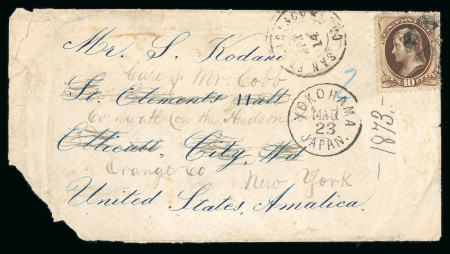
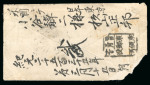
Yokohama. 1873, double-envelope system inner envelope: 10c Brown, tied by quartered cork cancel, with “Yokohama Japan Mar. 23” (1873) cds perfectly struck on envelope addressed in Japanese on reverse, dated by the sender (“2535.3.15”) and showing framed early non-standard datestamp “(year of the) rooster 3rd month 17th day / Tokyo postal bureau” (Meiji 6.3.17), delivered to the U.S. post office in Yokohama with address to S. Kodani, Ellicott City Md., changed to care of Mr. Cobb, Cornwall-on-the-Hudson N.Y., which appears to have been changed in Japan, not as a forwarding address (the addressee left Japan for the U.S. one year earlier to study). Carried on PMSS Colorado, departing 23 March 1873, arriving to San Francisco on 13 April, showing “San Francisco Cal. Apr. 14” cds on obverse. Bottom left corner torn off, minor soiling and small faults.
The third example of an inner envelope with Japanese address and postmark carried to the U.S. post office, exhibiting a very rare usage of a Japanese postmark on the inner envelope.
Note: The official “double envelope” system was introduced by the “Overseas Mail procedure” of Meiji 5.3. The double-envelope system was used to enhance the communications for Japanese nationals as well as foreign employees (“oyatoi gaikokujin”) in the outer provinces. It consisted of two envelopes, including a smaller-size inner envelope (the example presented here), which had to contain the letter inside and indicate the addressee outside.The outer envelope had to be addressed to “c/o Tokyo General Post Office, Foreign Mail dispatching process”. In Tokyo, the outside envelope was opened, and the inner envelope had to be franked with foreign stamps as required, to be forwarded to the Yokohama’s foreign post office of choice (the U.S. post office in this case). The outside envelope had the address also in Japanese and internal postal markings, and it was franked combining an inland and foreign rate paid with Japanese postage. As the outer envelope had the Japanese postmarks and this envelope was usually discarded, Japanese postmarks on the inner envelope are extremely rare. The inner envelope was prepared by a Japanese, who addressed both envelopes in Japanese.
Provenance:
Japan Stamp Auction, Osaka, November 2017 sale
“Magnolia” (Part 4, Robert A. Siegel Auction Galleries sale 1271, 13.12.2022, lot 336)
Additional scans and images are being uploaded on a continuous basis, and the complete set of illustrations for all lots will be available by 1 June 2026.
Should you require further images after this date and are unable to find the material you need online, please do not hesitate to contact us.
For further information regarding this lot, please contact us.