


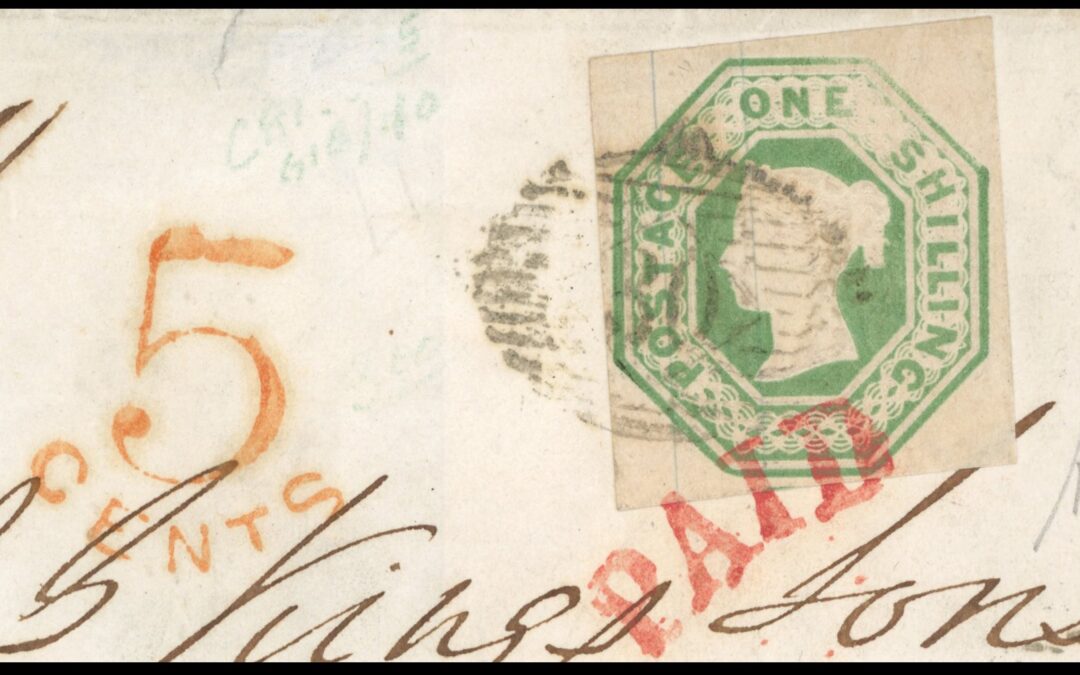
Part 1 of the Tomasini collection of Great Britain, coming up for auction on March 26th 2026, features some stunning Line Engraved and rare Surface Printed issues, but the section of 1847-54 Embossed issues is as equally impressive, albeit not as well loved by collectors these days for some reason. So in this article I’m going to try my best to instill some enthusiasm into collectors by highlighting the importance of this issue in the history of GB philately and the rarity of the items on offer in this auction.
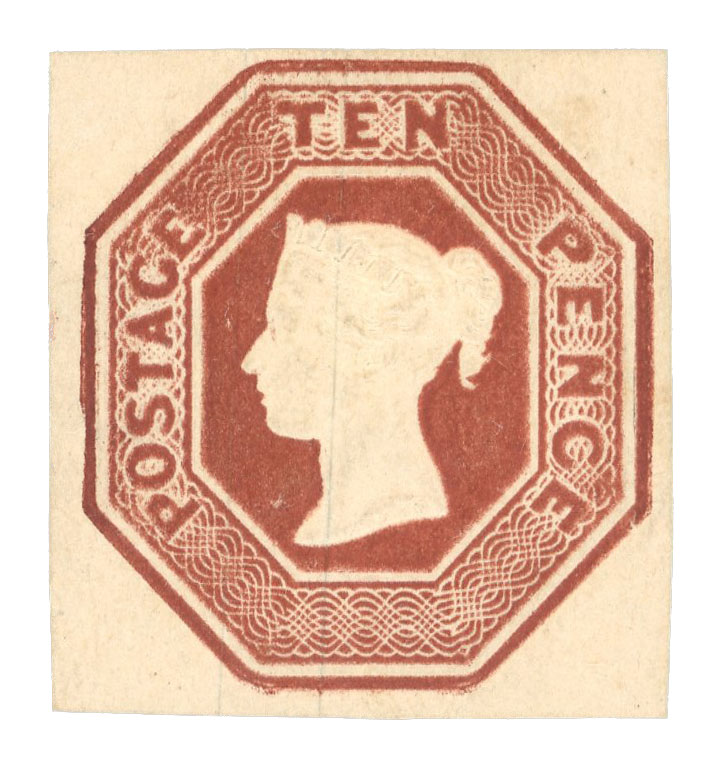
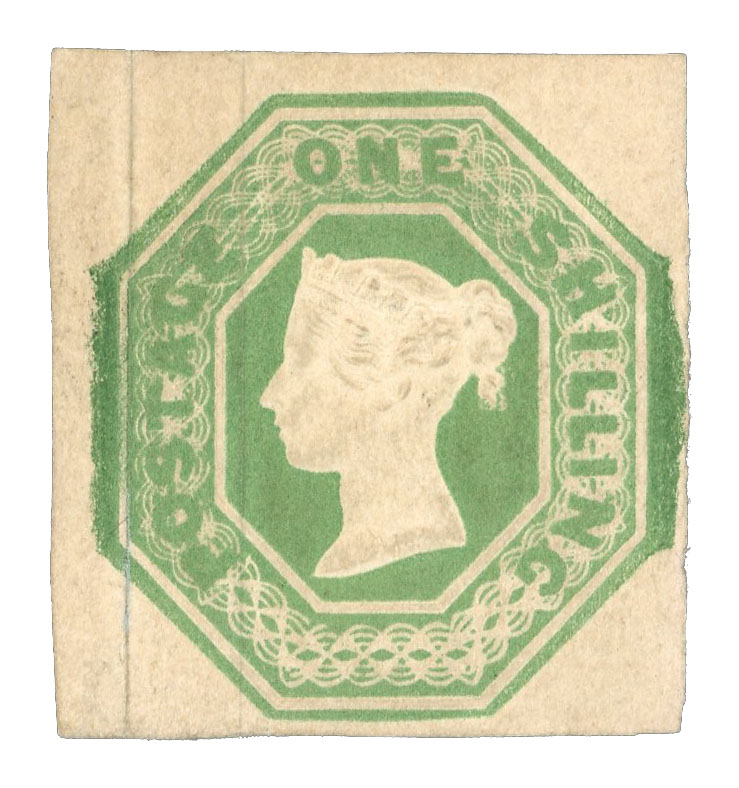
Background to the 10 Pence and 1 Shilling
When the Penny Black, Twopenny Blue and Mulreadys were issued in 1840, it seems that mail to overseas destinations had been given little thought. At this time prepayment of the mail to all countries except British North America and the West Indies was compulsory, but no plans had been made for postage stamps to pay the high postage rates (mostly over 1s).
So for the majority of mail abroad pre-payment of the postage was still paid in cash, although philatelists are very grateful some people did partly pay or completely pay the postage in 1840 issues and plastered their letters with them even though it wasn’t particularly practical to fit all the stamps and the address onto the front, let alone the time taken to affix the stamps and cancel each one. Theo Brauers (ref #2), records 200 such letters.
Politics played its part in the delay of higher values, with the Conservative government of the early 1840s feeling that the uniform penny postage rate was too low to begin with, and it wasn’t until 1846 and with a Liberal government that things began to change. One of the first acts of the Postmaster General, the Marquess of Clanricarde, was to appoint Roland Hill as his secretary. The pair pushed forward the agenda of postal reform, and Clanricarde’s suggestion of a 10d and 1s values was put forward by the Treasury to the Commissioners of Stamps and Taxes.
The Board of Stamp and Taxes had their doubts regarding the cancellation of the stamps already in use and strongly urged that the intaglio (line engraved) process should not be used for this reason. Having had experience of the embossing of the stamps on the 1841 postal stationery envelopes, they made their recommendation:
« The embossed stamp now impressed solely on envelopes appears to us to posses great advantages in respect of obliteration over the labels, as the head, being prominent, cannot escape contact withthe obliterating stamp, and being free from ink, and consequently from varnish, freely imbibes the obliterating ink, and being White shew the ink of the obliterating mark with perfect distinctness ».
In October and November 1846 the Board conducted a number of experiments with a view to selecting the paper and method of printing to make the stamps most easily distinguishable between the two values proposed and the low-value stationery, and to make their re-use impossible (which was of more concern than forgery).
William Wyon, the celebrated sculptor and Chief Engraver of the Royal Mint (whose Guildhall Medal of 1838 had served as the basis for the Queen’s head on the 1840 issues) had engraved the dies for the embossed postal stationery of 1841. Wyon now produced an octagonal format to make the stamps visibly different to the stationery dies. The Board suggested that yellow, light green or black ink would provide further distinction.
A curl to the back of Queen Victoria’s hair was added to his original dies, which differs slightly between the 10d and 1s. At the same time the surround was engraved with a reticulated framework and the value were added to the punch die, an intermediate stage between the original and working die, which was done by Thomas Moss at Somerset House. The working dies bore the uncoloured letters « W.W. » (for William Wyon) and the die number, situated at the very base of the portrait (fig. 4). Two dies were used for the 1s and four dies were used for the 10d. Often this is hard to see due to it being poorly impressed.

Fig. 4: Close up of lot 20090, showing the « W.W. 2 » embossed lettering for die 2 at the base of the neck.
There was some delay in approving the designs due to a dilemma at the Post Office concerning the method of recompensing postmasters for selling these stamps. Opinion was divided between selling them at face value (like the existing stamps) or allowing them to take a percentage and sell them above face value (like the postal stationery). The latter was adopted.
However Wyon was a busy man in 1847, with commissions for service and campaign medals which took priority. So although it had been intended to issue both the 10d and 1s at the same time, only the 1s was released on 11th September 1847, with the 10d not issued until 6th November 1848.
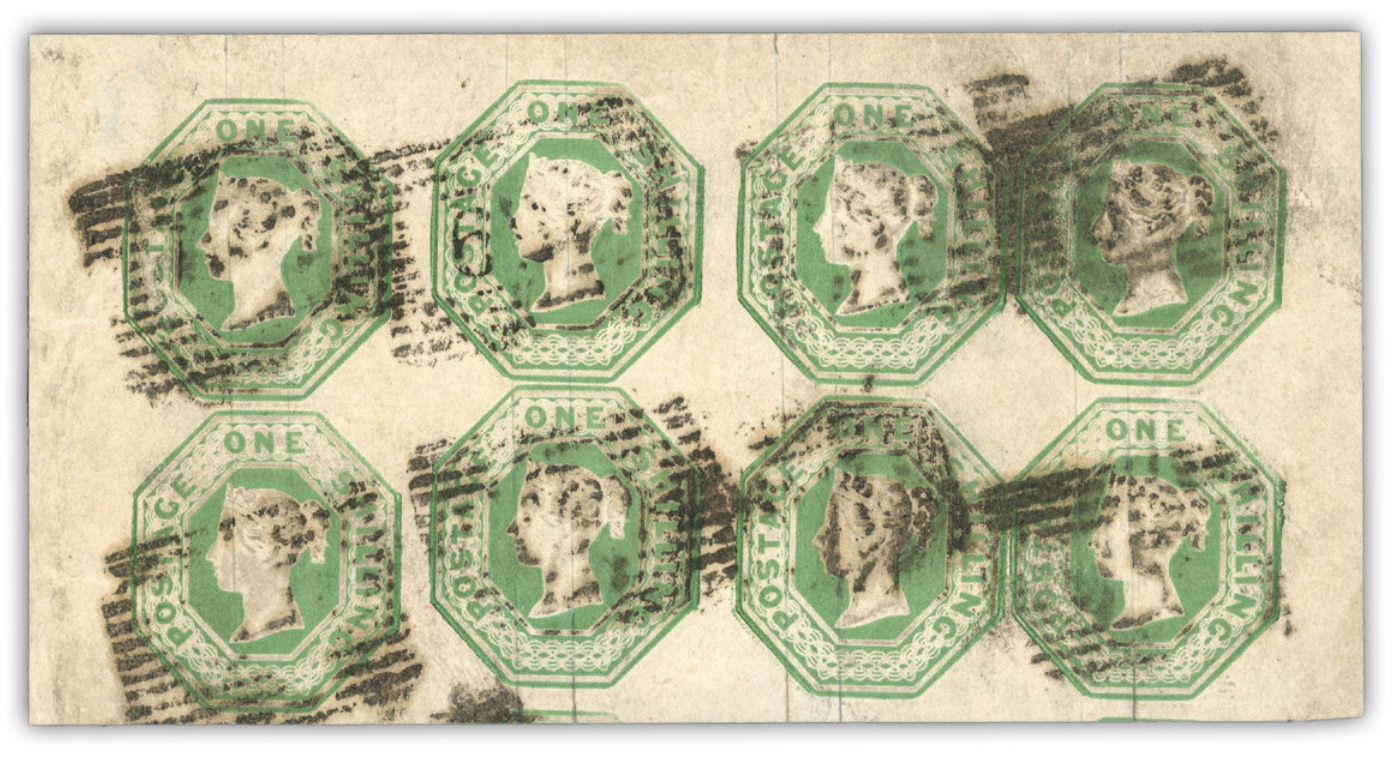
Fig. 5: Lot 20091 from our March 26th 2026 auction, a top sheet marginal block of eight used in Glasgow, Scotland. This block is a good illustration of the irregular spacing of the dies produced by the printing process.
Printing
Although the stamps were satisfactory, the method of production was slow and expensive. The embossing was carried out by the Board of Stamps and Taxes at Somerset House with one impression applied to the sheet at a time and aligning them accurately proved extremely difficult with many impressions very close together or overlapping (see fig. 5). Hence today that used examples are reasonably plentiful, but well-margined examples are very hard to come by. This also meant the stamps were unsuited for perforation once that means of separating stamps came into use.
The paper used had what is known as a « Dickinson silk thread », which is two strands of twisted blue cotton yarn spaced approximately 5mm apart passing vertically through the dies as a security feature. Examples with misplaced threads 20mm apart (fig. 6), only one thread at side or omitted due to misplacement are listed by Stanley Gibbons.
The 1s can be found in pale green, green and deep green shades, and the 10d in brown or deep brown shades.

Fig. 6: Both sides of a 10d embossed showing the threads misplaced and 20mm apart, which will feature in part 2 of the Tomasini collection.
Distribution
The Board of Stamp and Taxes initially recommended that the sale of the high-value stamps be confined to Post Offices in England and Wales handling over 10’000 letters a week and offices in Scotland and Ireland handling over 3’000 a week (as these countries had a proportion of mail sent abroad to emigrants to the Colonies). In the end 57 provincial towns in England and Wales (Guernsey, Jersey and Isle of Man included), 30 towns in Ireland (see fig. 8) and 20 towns in Scotland (see fig. 7) received the stamps. Since postmasters were earning a percentage from the sale of these stamps, this of course led to appeals from Postmasters from those Post Offices not deemed important enough to stock them. An announcement in April 1850 finally permitted the sale of both stamps at all Post Offices throughout the United Kingdom.
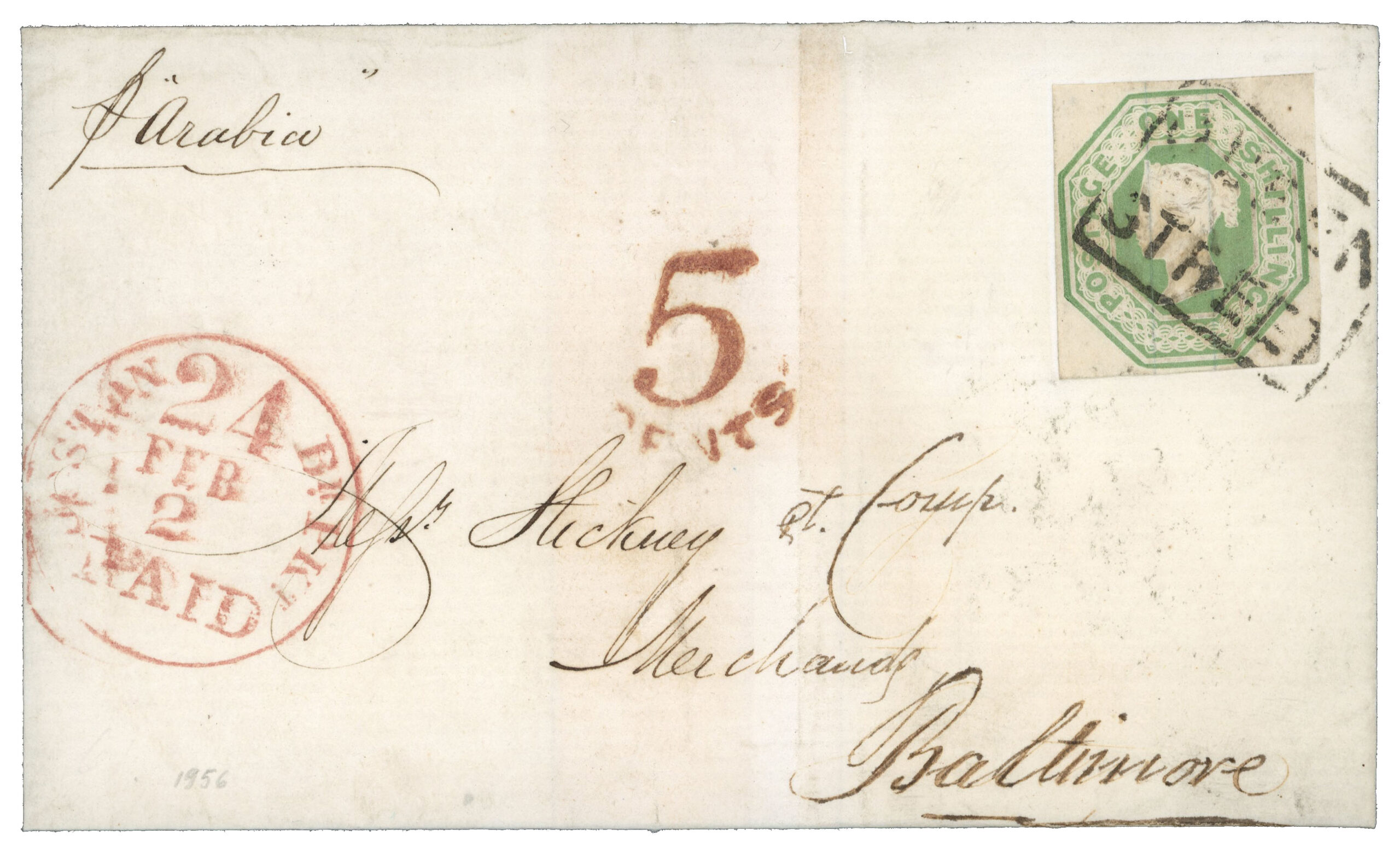
Fig. 7: Lot 20114: Cover from Scotland with 1s green tied by « Scots Local » Queen Street boxed handstamp.
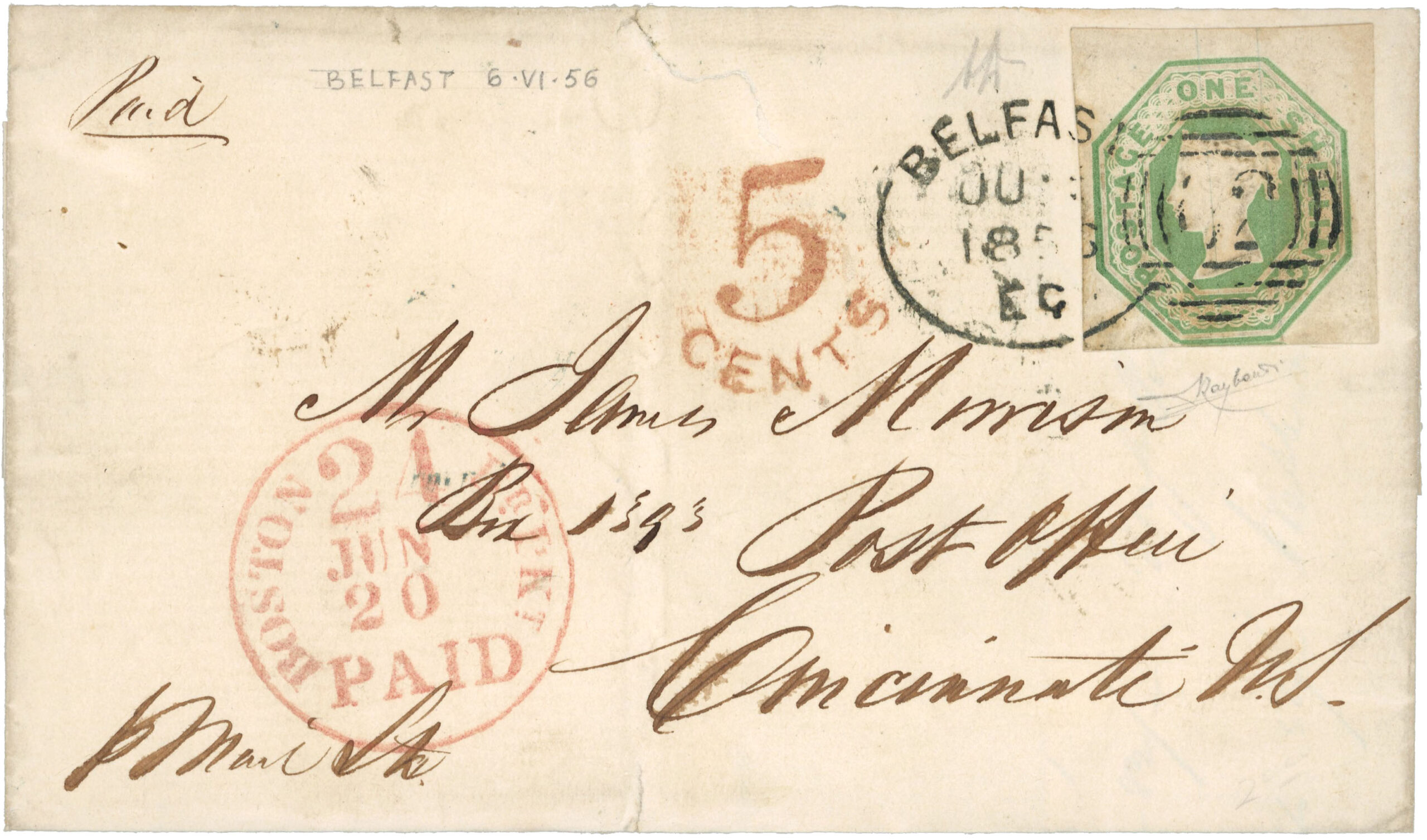
Fig. 8: Lot 20119: Cover from Ireland with 1s green tied by Belfast « spoon » datestamp.
The 6 Pence
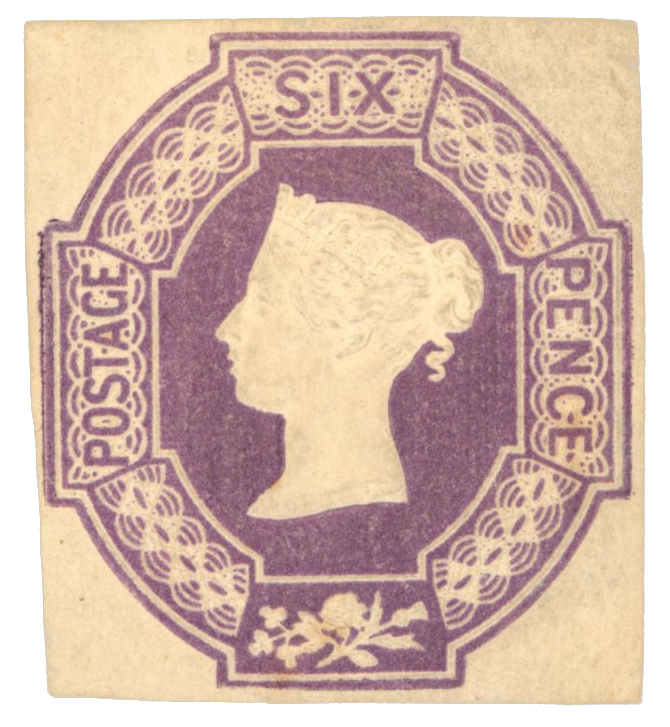
Postage stamps weren’t allowed to be used to pay the registration fee, which was 1s from 6th January 1841 up to 28th March 1848, when it was then reduced to 6d thanks to the efforts of Roland Hill. It wasn’t until 1st June 1850 that Postmasters were instructed to affix stamps to a letter to denote the registration fee. It was Roland Hill’s intention to introduce a 6d to pay the fee as well as for an anticipated reduction in the rate to France which never materialised. So by 1851 the Post Master General acted on Hill’s recommendation and was granted the necessary permission from the Treasury on 8th September to produce a 6d value.
William Wyon was again responsible, but his design differed from the previous two stamps with trapezoid panels at the top, bottom and sides of the oval, with « POSTAGE », « SIX » and « PENCE » at the left, top and right respectively, and a spray of flowers at foot. Only one die was used for the 6d.
This time stout handmade paper (of variable thickness) was used (instead of the silk thread paper) with a « V R » monogram watermark. This may be found inverted or inverted and reversed as often as the normal watermark.
Colourless gum was used at first, but following an incident in which several sheets were printed on the gummed side, it was decided to add a greenish tint to the gum (fig. 9). Some 6d stamps were also printed on thick cartridge paper with silk threads enmeshed.
The 6d went on sale on 1st March 1854, and coincided with the reduction of postal rates to many places abroad. Why it took over 2 years from approval to releasing the stamp has not been fully explained by any archive papers. However William Wyon did die on the 29th October 1851, with his son then taking his place. Perhaps as before, the Royal Mint thought it was more important for him to be working on medals and coinage.

Fig. 9: Embossed 6d mint block of four, below showing the reverse with greenish tint applied to the gum, which will feature in part 2 of the Tomasini collection.

Usages
As already mentioned, these high values were produced in order for people and businesses to prepay the postage to foreign destinations. Before the UPU standardised international mail delivery by establishing a uniform postal rate and equal treatment between domestic and foreign mail in 1874, every pair of countries that exchanged mail had to negotiate a postal treaty with each other. In the absence of a treaty providing for direct delivery of letters, mail had to be forwarded through an intermediate country. For example the UK at this time mail to France or the USA was carried by ship directly so was reasonably straight forward with the basic rate being 10d and 1s respectively. But for example mail travelling overland through Europe the postage rate had to take into account what each country had negotiated with the UK for their share of the cost of transporting the mail in their postal system. This produced a range of rates and different franking combinations, and heavier business mail can be found with multiples of the high values with the rate steps going up every half ounce (such as fig. 11).
The postal history of this issue has the added interest that the ships which carried the mail are sometimes endorsed on the cover or can be identified by the transit markings on the covers. And it wasn’t just Royal Mail Ships (RMS) that were permitted to carry the mail. Companies such Cunard, P&O, White Star, Orient Line and HAPAG would carry mail from the UK through the Atlantic, Mediterranean, Indian Ocean and Pacific Ocean. There are collectors for certain companies, certain routes (such as transatlantic mail) and even certain ships. Isambard Kingdom Brunel’s S.S. « Great Britain » being one of the more famous ships from this period which saw service between the UK and USA and later the UK and Australia. Dates are important as ships’ maiden voyages can carry a premium. The first part of the Tomasini collection of Great Britain includes covers carried onboard ships such as the Arabia, Caledonia, America and Baltic.
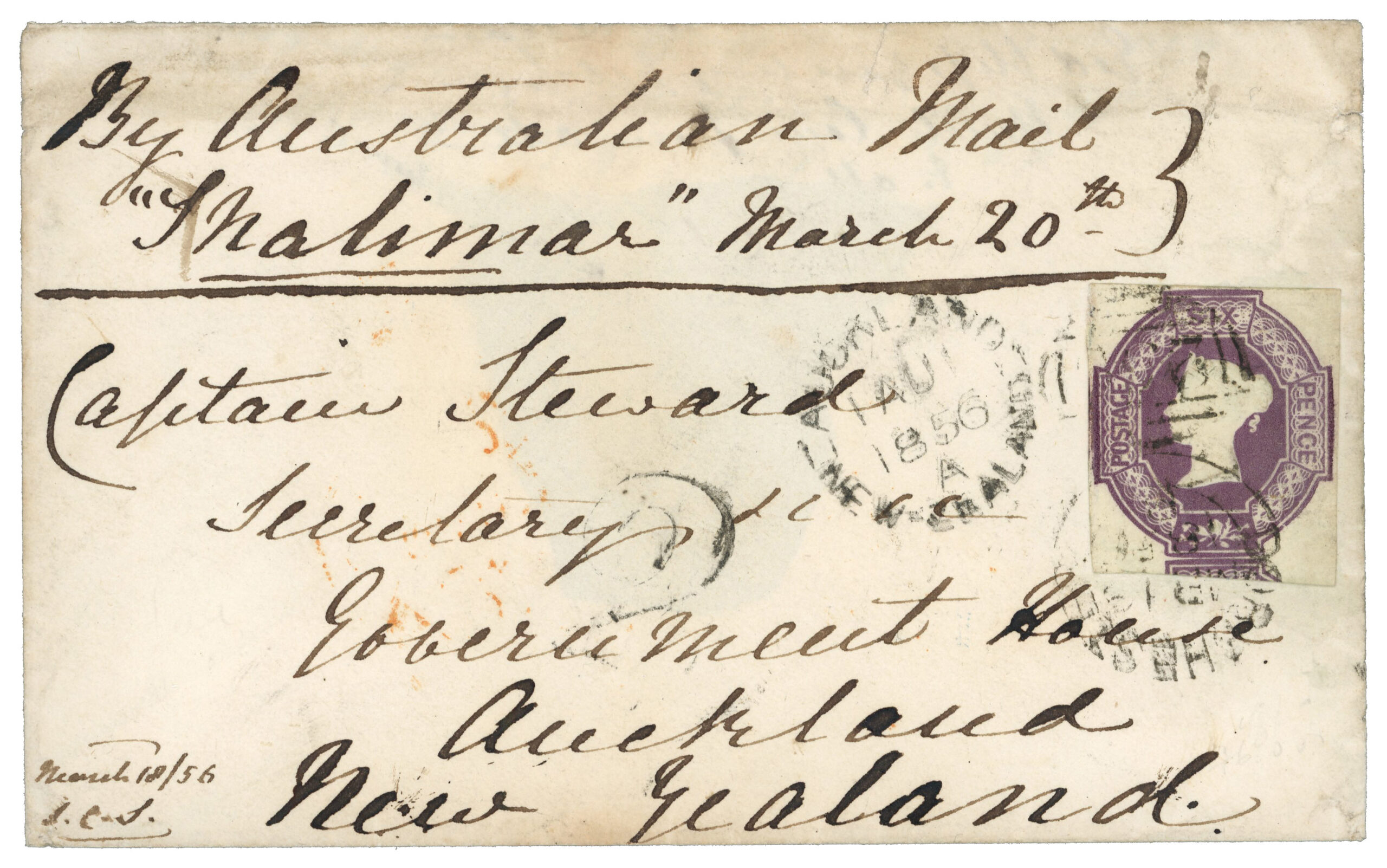
Fig. 10: Lot 20115, 1856 envelope from Dorchester to New Zealand endorsed « By Australian Mail Shalimar » with 6d Embossed.
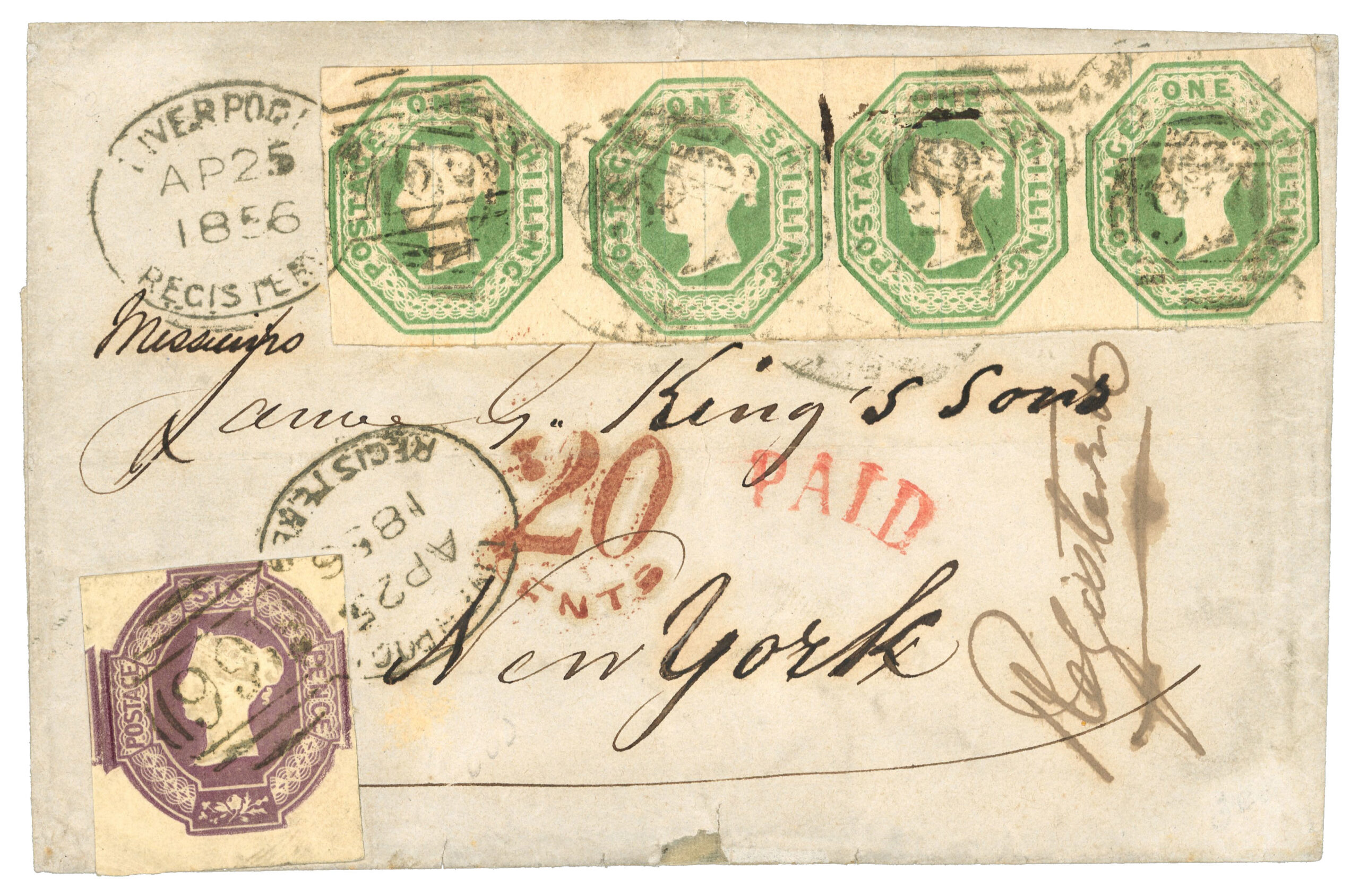
Fig. 11: Lot 20116, 1856 cover from Liverpool to the USA by Cunard Packet « Baltic », with 1s strip of four paying quadruple rate and 6d paying the registration fee.
Succession by the Surface Printed Issues
The Post Office needed a new 4d value in 1855 and decided to use the surface printing method. The Embossed stamps were relatively expensive and time consuming to produce, and because of the thick paper and embossing, the gum didn’t adhere the stamps to the envelopes as well as needed. As a result of this decision, and the success of the first value, the Embossed stamps were replaced by De La Rue printings, the 6d and 1s in October and November 1856.
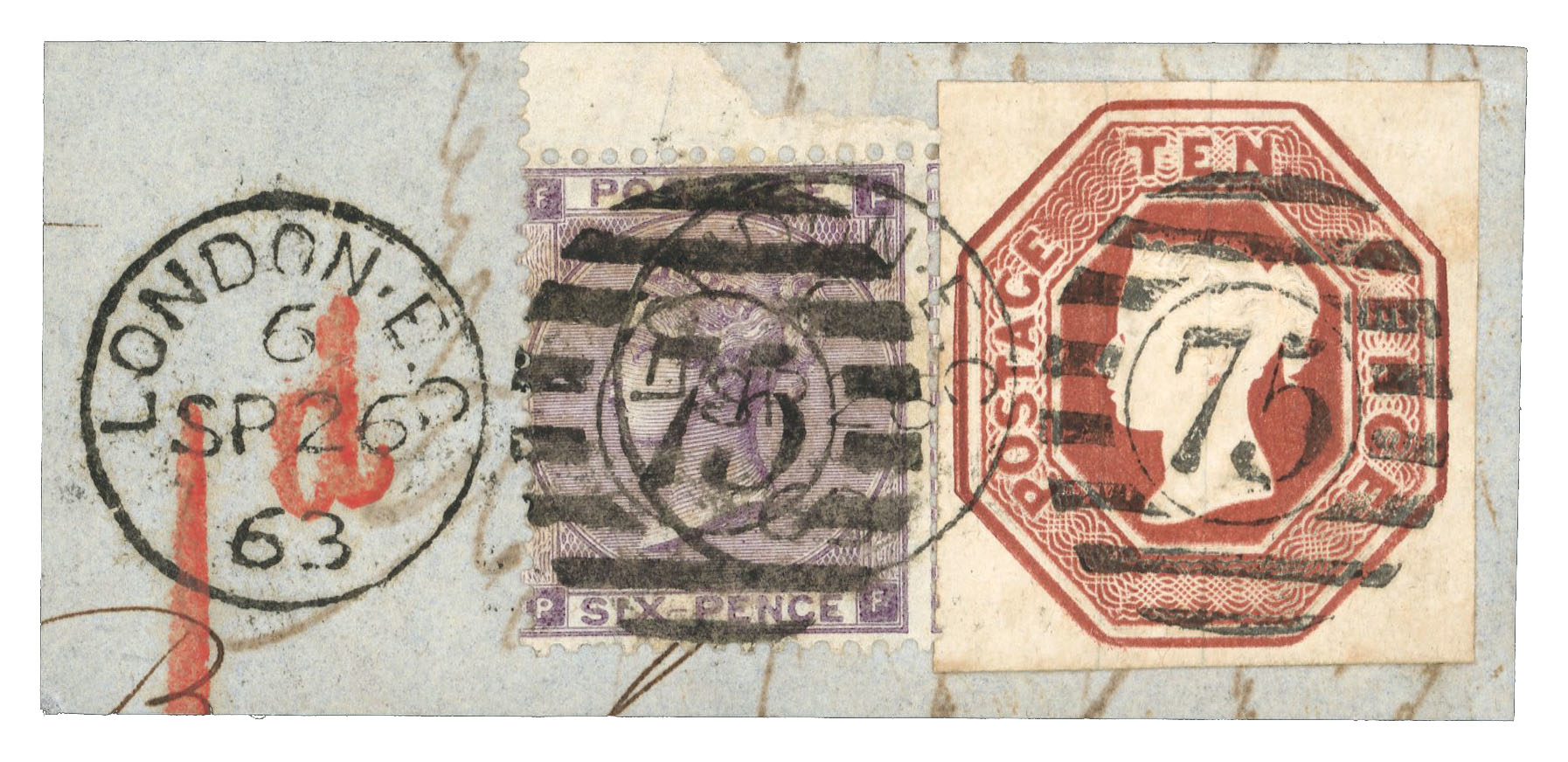
Fig. 12: Lot 20103: Piece from 1863 from the period of re-use of the 10d Embossed in combination with a Surface Printed 6d.
Owing to the reduction from in the postage rates to France from 10d to 4d on January 1st 1855, the demand for 10d stamps so declined that they were withdrawn on August 15, 1855. However rate changes in 1862 and 1863 to several destinations meant there was again a demand for a 10d, so sheets left over at Somerset House were re-issued. However the number of recorded usages is very small, with only ten covers, seven pieces (fig. 12) and a single stamp known (see ref.#4). These rate changes didn’t last long and the 10d was finally replaced with a surface printed stamp in 1867.
References and Further Reading
- « British Letter Mail to Overseas Destinations 1840 to UPU » by Jane and Michael Moubray »
- « Not Intended For This Purpose » by Theo Brauers
- « Under the Gum: Background to British Stamps 1840-1940 » by James A. Mackay
- GB Journal vol. vol. 41 no.1 p14 by Johnson, vol. 41 no. 5 p.85 by Huggins, vol. 42 no. 5 p.95 by Huggins, vol. 49 no.6 p.137 by Reid, vol. 54 no. 6 p.128 by Jackson and vol. 55, no.1, p.18 by McCann.