


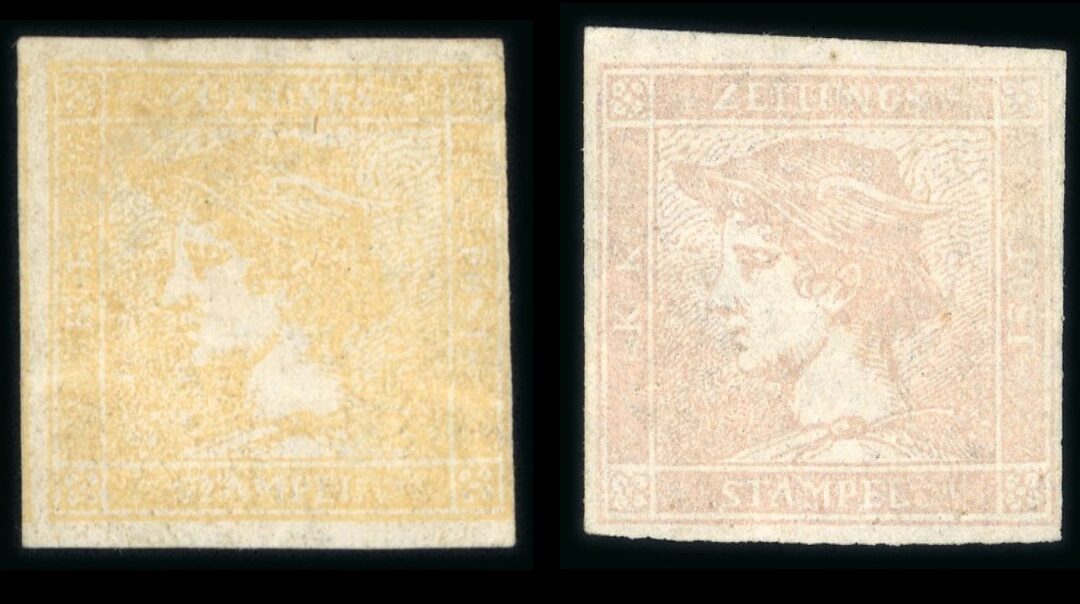
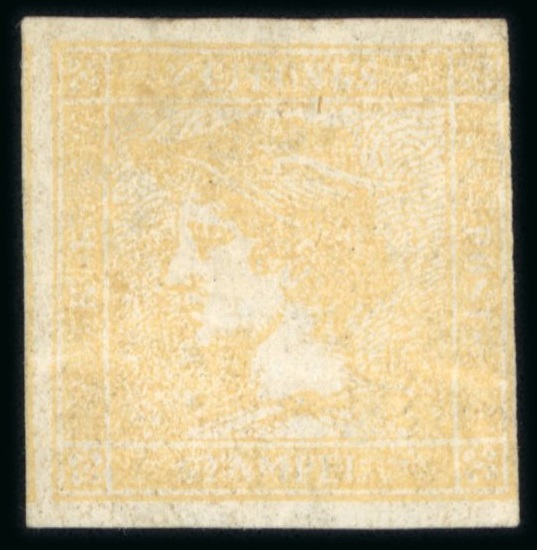
One of the highlights of our May 28th-June 1st auction series is the Karl Korn collection of mint Austria 1850-1938, which includes mint examples of Austria’s most iconic stamps, the Mercury Heads. The 0.6Kr value is reasonably common, with lot 10060 being a particularly attractive example. However it is the 1851 6Kr yellow, 1851 30Kr rose and 1856 6Kr vermilion that are the major rarities of Austrian philately.
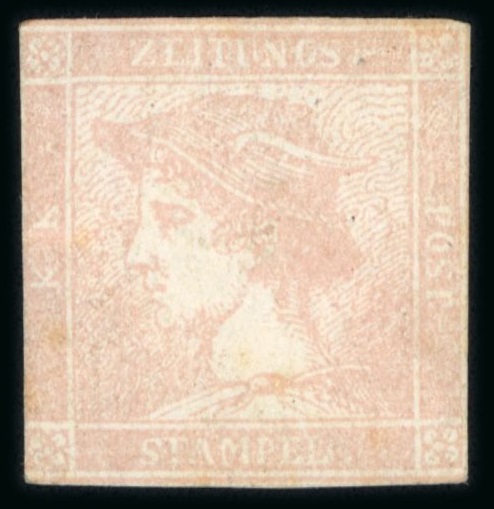
Lot 10063 is the 30Kr rose and is one of only very few flawless unused examples to have survived, as virtually all others exhibit more or less severe defects or don’t have clear margins all around. According to research by Matthias Fukac, this is one of the most beautiful known. It is estimated at CHF80’000-120’000.
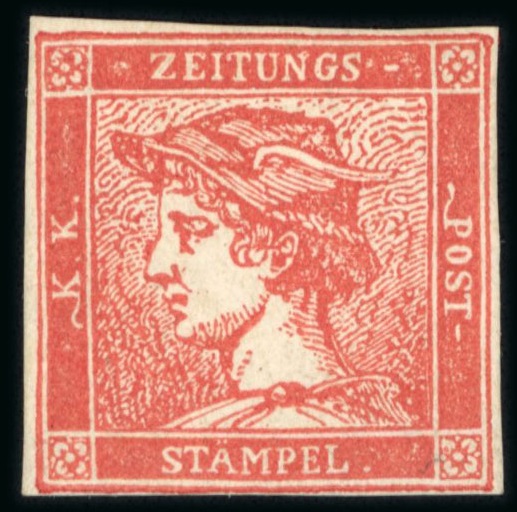
Lot 10064, the 1856 6Kr vermilion, although nearly as rare, is estimated at a much lower estimate as it’s just cut into at the left and has two small repairs, so is estimated at a very attractive CHF10’000-20’000, given its rarity (it is catalogues at €120’000 in the ANK catalogue).
And if you want to take all three of these rarities home with you, then you can bid on lot 10058, which includes the 1851 6Kr yellow, 1851 30Kr rose and 1856 6Kr vermilion and has an estimate of CHF100’000-120’000.
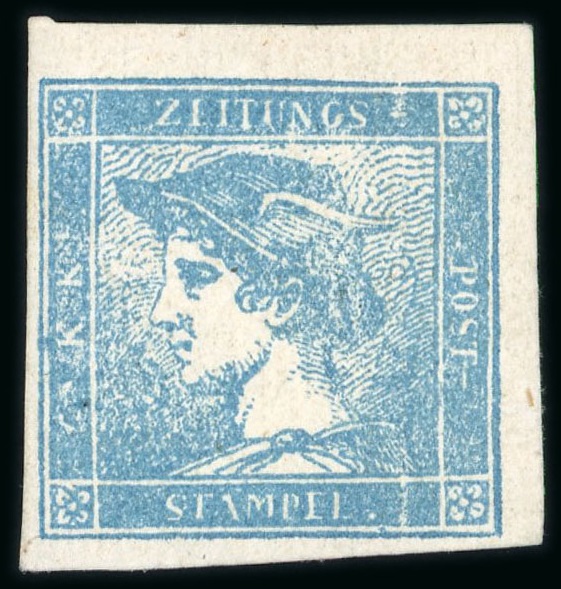
Lot 10060
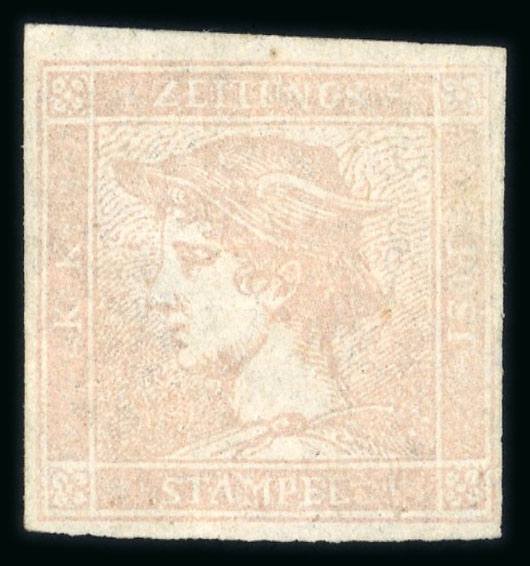
Lot 10063
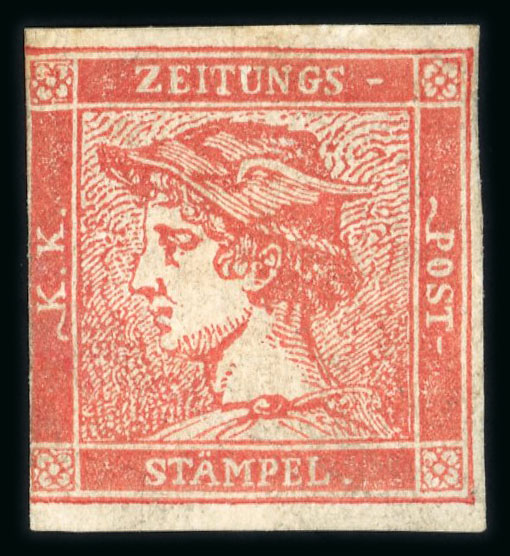
Lot 10064
Lot 10058
Below is an extract taken from the Encyclopaedia of Rare and Famous Stamps, vol.1, pg.1-2, 1992, by L. N. Williams, which gives more details about their production and usage.
The Mercuries acquired their nickname because the main feature of the design common to all values is a head of Mercury; Austria was the first country to adopt for its stamps the apt representation of the Messenger of the Gods.
The stamps were issued exclusively for use by the publishers of newspapers for franking copies of the journals distributed through the post to inland subscribers. The issue was authorised by a decree dated 12 September 1850, which related to stamps printed in blue, without any indication of value on them, but to be sold for 1 gulden (60 kreuzer) per hundred. Another decree on 3 December referred to similar stamps printed in yellow, which would be equivalent to ten blue stamps and in red (actually rose) which would have a value equal to fifty of the blue. The decree specified that this method of prepaying newspaper postage would come into force on 1 January 1851, when the stamps would be issued.
The Mercuries were designed by Josef Axmann and they were produced and typographed at the Imperial State Printing Works, Vienna. The sheets contained 400 impressions arranged in four panes of 100.
The blue stamps were sold in quantities of 100 or multiples thereof and one stamp had to be affixed to each newspaper wrapper. Stamps of the other colours were affixed to wrappers enclosing ten or fifty papers, as the case might be. Those wrappers were removed and often destroyed by the clerks in the receiving post offices which acted as distributing agents so it is not surprising that the yellow and rose Mercuries are very much rarer than the blue.
Although at first it was intended that the stamps should be used only within Austria, on 28 March and 31 July 1851 they were authorised for use on newspapers sent to foreign subscribers. That additional validity was rescinded at the end of 1851.
Apparently the demand for the rose stamps was small, for in October 1852 they were devalued and the remainders were put on sale together with and at the sane price as, the blue stamps. Similar action was taken in the case of the yellow Mercuries on 21 March 1856. On that day, however, a new stamp was issued. This was later to become the rarest of the quartet. Its colour is a rich vermilion., but collectors are satisfied to call it simply red. It is the pride of the Austrian philatelist for it is his country’s rarest normal stamp and one needs but to mention the magical words « rote Merkur » to see him puff out his chest and a sparkle come into his eyes.
The franking power of each red Mercury was equal to that of ten blue stamps. The design was unchanged except for a slight variation in the shape of the G in the inscription ZEITUNG at the top of the stamp. In the previously issued stamps the G is rather badly shaped, something like a poorly formed C with scarcely any cross-bar. The red stamps show a much more definite G, rounded and with a prominent cross-bar. The red Mercury exists only in the second type, the yellow and rose Mercuries only in the first type, while the blue Mercury can be found in both types.
Austria’s first newspaper stamps remained in use until November 1858, when they were replaced by an issue bearing the head of the Emperor Francis Joseph I.
Below are the words an old collector who described an experience which, had he taken advantage of it, would have resulted in the greatest find of early Austrian newspaper stamps ever made. The present-day value of the twenty odd red Mercuries would exceed that of the entire Nicholas Market today.
In Salzburg a bric-à-brac market has been held annually for more than a hundred years. It lasts from St. Nicholas’s Day (6 December) until Christmas Eve and is always known as the Nicholas Market.
There, every imaginable thing is offered for sale: old shoes and golden watches, top hats of all patterns, bird cages and mouse traps, old clothes cast off by fine gentlemen and their servants, calendars, prayer- and medical-books, porcelain and metal plates, gold medals and rusty pistols, in short, everything which is obtainable from a bric-à-brac dealer.
Several curators of museums, and private collectors have picked up, for a few kreuzer, treasures which could not have been bought elsewhere for many gulden. Only last year a Strassoldi violin was sold there for 15 gulden (about £1.50). To come to the point; it was in December 1875 that I paid my regular visits to the Nicholas Market. As I used to go there several times each day I gradually got to know all the articles by sight. On this particular day a new object caught my eye. It was a fire-screen, covered on one side with antique leather which was decorated with golden grapes and vine leaves, and on the other side with a grand array of old stamps. The side bearing the stamps must originally have been of leather too, but probably it became brittle from the heat of the fire and the leather was replaced by cardboard which was then covered with the little squares of coloured paper.
In the neighbourhood of my home at that time there was a wastepaper storehouse attached to a paper mill. We schoolboys were allowed to search for stamps among the old envelopes, letters and documents which filled the store house, and we found many fine specimens there; so that even in my early days I soon became an enthusiastic collector. However, none of us boys had ever before seen stamps such as those on the fire-screen. The border consisted of a zig-zag band made up of yellow Austrian and black Bavarian 1 kreuzer stamps. Inside this were numerous other stamps in a rectangular design, while in the very centre was a circle containing the letters ‘F.J.I.’ (Francis Joseph I) composed of red ‘Mercuries’.
The screen was to be had for 2 gulden 50 kreuzer, of which, no doubt, the 50 kreuzer could easily have been knocked off. In those days I did not realise the value of the stamps. In any case, I did not possess as much money as that, and my father would certainly not have given it to me. The letters in the circle were about 16 centimetres high and comprised more than 20 ‘Mercuries’.
The screen was exhibited at the Nicholas Market for three days. Who bought it or where it went I do not know, nor could I discover afterwards. It is quite possible that the purchaser took off the gaily coloured cardboard and put it in the fire, covering that side of the screen with cloth or leather to make it an attractive piece of furniture once more. Then again, perhaps the cardboard is lying somewhere in an attic, and after many years will gladden the heart of a lucky finder.