


Lot 40109 – RARE PAIRE D’URNES EN MALACHITE RUSSE MONTÉES EN ORMOLU, MILIEU 19e SIECLE PROBABLEMENT SAINT PETERSBOURG


Lot 40109 – RARE PAIRE D’URNES EN MALACHITE RUSSE MONTÉES EN ORMOLU, MILIEU 19e SIECLE PROBABLEMENT SAINT PETERSBOURG
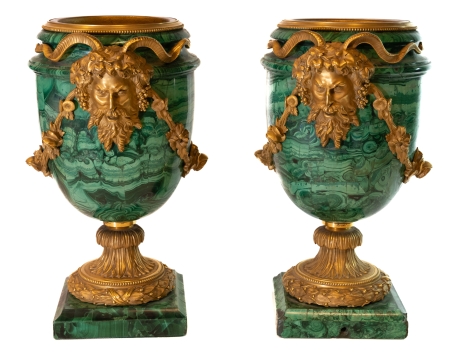
RARE PAIRE D’URNES EN MALACHITE RUSSE MONTÉES EN ORMOLU, MILIEU 19e SIECLE PROBABLEMENT SAINT PETERSBOURG
Chaque urne présente deux superbes masques de Bacchus encadrés par une guirlande de fleurs, entourés d’une couronne de feuilles et de baies et d’acanthes.
État : Une urne présente quelques restaurations sur le malachite, tandis que l’autre est en bon état ; les deux affichent de légères traces d’électrification ultérieure qui n’entravent pas leur incroyable attrait visuel. Hauteur : 35 cm.
Provenance : d’une collection suisse distinguée.
Remarque : La vogue russe pour la taille de la pierre a conduit à la création de certains des plus beaux objets d’art, notamment ceux en malachite. Le lapidaire de Peterhof était le plus célèbre des ateliers de taille de pierre russes, suivi des fabriques impériales à Ekaterinbourg. Le malachite est une forme stalagmitique de carbonate de cuivre, et la technique utilisée dans la fabrication d’objets et de meubles est connue sous le nom de mosaïque russe. Le malachite était découpé en très fines tranches, puis appliqué sur un fond en pierre ou en métal, les veines étant disposées pour former des motifs plaisants. L’ensemble était ensuite poli à la perfection, les jointures étant à peine visibles. Le lapidaire de Peterhof est la plus ancienne fabrique de taille de pierre, à quelques miles de Saint-Pétersbourg. Cependant, les grandes distances des mines et des carrières ont rapidement conduit à la création de la nouvelle fabrique impériale à Ekaterinbourg, au cœur des montagnes de l’Oural. La troisième fabrique la plus célèbre était Kolyvan, située en Sibérie occidentale. Peu de pierres ornementales sont aussi étroitement associées à la Russie impériale que le malachite. L’appréciation par l’aristocratie russe est attestée par les vases exquis et les plateaux produits par les lapidaires russes, culminant avec la construction de la célèbre « Salle de Malachite » au musée de l’Hermitage à Saint-Pétersbourg. Les objets en malachite ont également joué un rôle fondamental dans la section russe de la Grande Exposition de 1851 (A.N. Voronikhina, Malachite dans la collection de l’Ermitage, Leningrad, 1963, pl. 1 ; éd. L. Tonini, I Demidov Fra Russia e Italia, Florence, 2013, pls. I.1-I.4 ; II.1).
A RARE PAIR OF RUSSIAN ORMOLU-MOUNTED MALACHITE URNS, MID 19TH CENTURY, LIKELY CRAFTED IN ST. PETERSBURG.
Provenance: from a distinguished Swiss collection.
Note: The Russian vogue for stone-cutting led to the creation of some of the most beautiful objets d’art, most famously those in malachite. The Peterhof Lapidary was perhaps the most celebrated of the Russian stone-cutting factories, followed by the imperial factories at Ekaterinburg. Malachite is a stalagmitic form of copper carbonate, and the technique used in the manufacture of objects and furniture is known as Russian mosaic. The malachite was sawn into very thin slices and then applied to a stone or metal ground, the veins being laid to form pleasing patterns. The whole piece was then highly polished with the joins barely visible. The Peterhof Lapidary is the oldest stone-cutting factory, just a few miles from St. Petersburg, however the huge distances from the mines and quarries meant that it was soon joined by the new imperial factory at Ekaterinburg, in the heart of the Ural Mountains. The third most famous factory was Kolyvan, located in western Siberia. Few ornamental stones are as closely associated with Imperial Russia as malachite. The appreciation of this simple copper carbonate by Russia’s aristocracy is attested to by the exquisite vases and table-tops produced by Russia’s lapidaries, culminating in the construction of the famous ‘Malachite Room’ in the Hermitage Museum, St Petersburg, and malachite objets were fundamental to the Russia section of the 1851 Great Exhibition (A.N. Voronikhina, Malachite dans la collection de l’Ermitage, Leningrad, 1963, pl. 1; ed. L. Tonini, I Demidov Fra Russia e Italia, Florence, 2013, pls. I.1-I.4; II.1)
Des scans et images complémentaires sont ajoutés de manière continue.
Si vous avez besoin d’images supplémentaires et que vous ne trouvez pas les documents recherchés en ligne, n’hésitez pas à nous contacter.
Pour toute information complémentaire concernant ce lot, veuillez nous contacter.