


We’ve seen an increase in the trend for the unusual and realise it’s an ever important factor in people’s collecting habits. This could be for those who are looking for a more academically stimulating collecting area, or someone looking to be more creative with their collection (perhaps even just as a fun aside to their main collection). Below I write about how you can use our website to find items you’re looking for, or didn’t know you were looking for that maybe fit into more than one box (that’s not supposed to be a pun by the way!). It’s something that I haven’t seen other auction companies embracing on their websites, and putting my David Feldman rep face on, I believe puts us at an advantage over our competitors, which is a benefit to both buyers and sellers.
Our June 2026 auction series includes over 5’500 lots from around the world. Most of the time it’s easy to categorise where a stamp or cover should be placed in our listing, but sometimes one item could fit into more than one category. For example, a cover from the British Post Office in Haiti for examples could be of interest to a GB surface printed collector, a GB used Abroad collector or a Haiti collector. Historically a small number of auction houses have provided such cross-references for collectors in their catalogues. We have always provided an index of lots in our general catalogue but with printing deadlines always looming, it’s never as detailed as we would like. But once the catalogues are sent to the printers, we have more time to add secondary (or more) categories and tags to make lots more easily findable on our website. So below I will take you through our online catalogue search tools and how best to use them for your needs.
On our auction page listings, the left hand side of the screen (illustrated at right) has all the tools to help you refine what you are looking for. I’ll work my way down from the top and explain each feature.
Keywords search
The search box is the best way to find keywords in descriptions. Our search box also searches the category field (e.g. if you’re searching for De La Rue you will find stamps in the category “Great Britain » King Edward VII » 1902-10 De La Rue Issues”) and the heading field (which is our abridged version of the lot description above the description and also used on the list of lots).
Of course this is an international hobby of ours, and some philatelic key words can differ either side of the Atlantic or be in another language entirely. We describe our Swiss lots (and sometimes our Austrian and German lots) in German, our French lots in French and the rest in English. So we do occasionally include foreign translations of keywords in our descriptions and sometimes even translate entire descriptions when we know it might be important.
You can also add more than one keyword to the search box. However the limitation that our search box has is that you can’t use Boolean search techniques which allow you for example to search two words together only. For example with the Leathart collection of GB Specimens, some might light to search for “type 8” only and unfortunately that doesn’t currently work but we will correct this for our next auction.
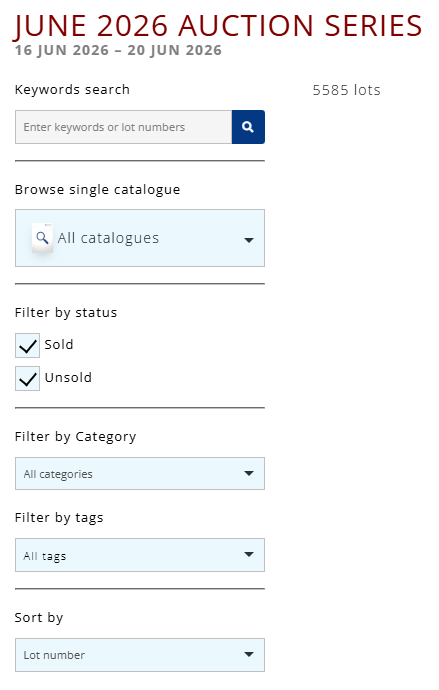
Browse single catalogue
Quite straight forward. This drop-down menu lists all the individual catalogues we have in the auction. If you select a catalogue then that means that any search of filter you make will be limited only to that catalogue.
Filter by status
This is only useful to people looking after the auction at what has and hasn’t sold and makes it easier for people to find unsold lots to make offers on.
Filter by Category
This is perhaps the most useful tool to finding lots that you are interested in that might be of interest to more than one collecting field. It is an alphetical listing of all the categories and subcategories of our auction lots. Our describing system allows us to choose multiple categories for each lot which makes cross-referencing simple. For example in this auction we have over 70 lots from the master forger Jean de Sperati which are spread throughout our auction week under the various countries, but by clicking on this link you’ll find that we have also a category “Sperati” in the drop down menu. We also cross-reference topics such as Foreign Offices, Occupations, mixed country and combination frankings, destination/incoming mail, airmail stamps and covers, etc. We’ve also worked hard on cross-referencing collecting interests under Thematics for what’s on the stamps such as trains, birds, animals, Scouts, and so on. There is also a category called Postal Thematics which includes subjects such crash mail, transatlantic mail, postal stationery, censored, etc. These are by no means a complete listing of all the various thematic interest we have in this sale but we constantly tag lots that should be tagged in the lead up to our auction and I’ll make sure our philatelists are more aware about doing so in the future.
Filter by Tags
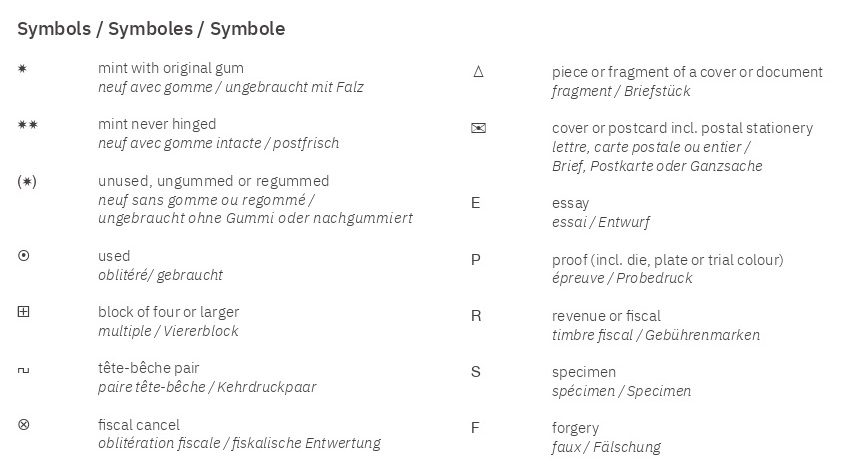
This drop-down box brings up a list of symbols. These are pretty much what have been used by stamp auction catalogues for many decades, but for anyone who doesn’t know I’ve illustrated what they mean in below (which can also be found at the back of all of our catalogues). The only one missing from the list is the “C” tag which has been put on every single group lot or collection in the auction. Very useful for the dealer or collector looking to start something new.
Sort by
This drop-down box offers the ability to sort the listing you have on your screen by lot number (which is the default), “Estimate ascending” which sorts the lots by lowest estimate to hightest estimate, and the opposite “Estimate descending”.