




Lot 20321 – 1921 10c Blue/Brown Abrazo de Acatempan with Inverted Center used
« EL ABRAZO DE ACATEMPAN »
THE RAREST STAMP OF MEXICAN PHILATELY
A GREAT GEM OF THE INVERTED CENTERS OF THE WORLD
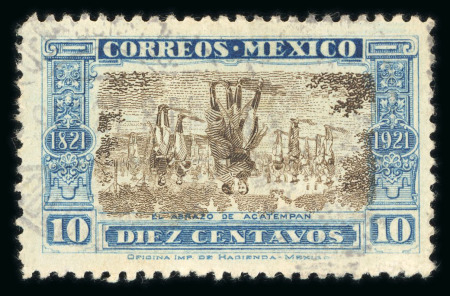
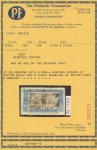
1921 10c blue and brown, « El Abrazo de Acatempan » with inverted center, delicately used with a faint strike of Mexico City cds (« bridge type ») with indistinct date, leaving the design so clear, slightly centered to right. Trivial paper disturbance confined to the margin at lower right, mentioned for the sake of accuracy. Cert. P.F. (1995), backstamped by John K. Bash.
Undoubtedly considered as the most important stamp of Mexican philately, with only two examples recorded, this being the finer. The other example known possesses a duplex cancellation which is believed to have been applied in Guadalajara, and which was struck covering a large place of the center inverted. Illustrated in the « Encyclopedia of Rare and Famous Stamps » by L. N. Williams (published by David Feldman, Geneva, in 1993), as the only stamp representing Mexico in this highly renownedencyclopaedia . A true world rarity.
Provenance (according to the research by L.N. Williams):
Mr. Roterberg (Mexican specialist of Chicago)
Alfred E. Fritz
Otto C. Yag
Eric Koenig
Note on the issue:
This stamp was issued to celebrate the centenary of the War of Independence. By 1820, the insurgent movement in Mexico, unlike the movements in South America, was completely and militarily annihilated. However, there were still a few guerilla fighters in the country; among them, Vicente Guerrero in the state that nowadays has his name, and Guadalupe Victoria in Veracruz. The possibility of emancipation from Spain was very distant. Nevertheless, within one year Mexico attained its independence. A liberal movement that arose in southern Spain in 1820 forced the ruling king, Fernando VII, to pledge the Constitution and convene the courts. The king feared that he would be overthrown and asked the Viceroy of New Spain to carry out independence. Agustín de Iturbide became the leader of the movement and sought the support of Guerrero, who accepted an interview that was held in Teloloapan on March 14th, 1821. The following day, Guerrero’s troops were inspected near the town of Acatempan. The official history narrative, probably seeking to contribute to the construction of Mexico’s nationalist symbolism set, affirms that the two men hugged. Whether or not there was an actual hug, the event marks the birth of Mexico as an independent country.
Jesús Nieto Hernández painted the scene which, one hundred years later, was reproduced on the 10 centavos commemorative stamp. It was designed by A. Barron and engraved in recess by E. Valadez to be printed in two colours. That involved the production of separate dies for the frame and the center. On the die for the frame of the 10 centavos, neatly ornate in the style appropriate to the early 1920s, was inscribed at the top CORREOS MEXICO, with the value DIEZ CENTAVOS at the foot, which appeared repeated on either side of the wording. Above the value in words, on an uncoloured ground, it appeared the title of the picture: EL ABRAZO DE ACATEMPAN, and the framework was completed across the foot with the printer’s imprint reading OFICINA IMP. DE HACIENDA-MEXICO. Each ornate side panel featured a tablet with a date; as printed, the left one is 1821 and the right one is 1921. The overall dimensions of the frame are 36.75 millimetres horizontal and 22 millimetres vertical, including the printer’s imprint at the foot. On the die for the center, translated into lines and dots, it exhibits the engraving of the painting by Hernández. From each die a plate was prepared featuring 50 repetitions of the design — frame or center — in ten rows of five. Imperforate color proofs or trials are known. The stamps were printed on white, wove, unwatermarked paper and were perforated on a machine with a perforating head which resulted in a gauge of 11.9 (for all practical purposes it is perf. 12). The mistake at hand resulted when a printed sheet with the frames was introduced upside down to print the centers, thus resulting in an inverted center. As only two examples are known to exist, it is believed that only one sheet was printed this way.
Legend has it that one of these examples was found in New York City by a young collector in a package of used stamps. It is maintained, though, that the owner was Irving Ingraham, who apparently bought it in 1940 at an auction from Mr. Philip H. Ward. The example seen here was owned by Alfred E. Fritz, a collector from Chicago, who bought it from Mr. Rotenberg, a stamps specialist in Mexico. Otto Yag, a known scholar of the Mexican post stamp, bought it from a merchant in Chicago and sold it to Erich Koenig. The Koenig collection was auctioned by Sotheby’s on May 30 and 31, 1995 (lot 704).
Des scans et images complémentaires sont ajoutés de manière continue, et l’ensemble des illustrations de tous les lots sera disponible d’ici le 1er juin 2026.
Si, après cette date, vous ne trouvez pas les images souhaitées en ligne, nous vous invitons à nous contacter.
Pour toute information complémentaire concernant ce lot, veuillez nous contacter.